I love Victorian divorce papers: little treasure troves of sex and intrigue among the middle and upper classes. Tiny insights through the heavy-backed curtains into the horror and pain of domestic violence. Things you weren’t supposed to know, laid bare, clinical, legal. A rupture in Victorian morality, a wound in the cosy domestic sphere.
When my husband was researching a ship for me, he mentioned that the ship-owner, John Henry Harrowing, had divorced his first wife on account of her committing adultery with no less than three men, I couldn’t resist looking it up. “I bet there was more to it than that“, I said. And boy, was there!
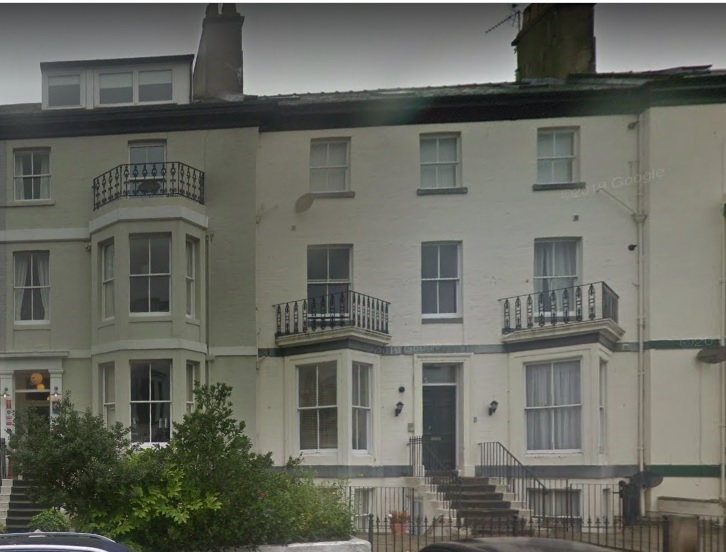
John Henry Harrowing was born in Whitby in 1859. His father, Robert, had been a tailor, but went into shipping in the early 1850s. The Harrowings were wealthy. John’s mother, Jane Ann Tesseyman, was Robert’s second wife. She was from Northallerton, and her father made timepieces. Robert and Jane had married in 1856, four years after his first wife died in childbirth, and Jane raised his surviving daughter. They lived in newly built Havelock Place overlooking the harbour mouth:
John’s mother, Jane, died giving birth to her short lived seventh child in 1866, aged thirty-eight. Robert left his children in the care of his elderly mother, and remarried in Croydon in 1871. Although this was a long way from Whitby, his business was based in East Cheap in London. His new wife was Catherine Isabella Wilkinson, from Sheffield. They had no children together.
At some point after this third marriage, Robert purchased Aislaby Hall, three miles from Whitby. The seven surviving Harrowing children moved in with their father and stepmother, and probably their elderly grandmother as well, although she died in 1874. The children’s number reduced to six in 1876, with the death of the eldest son Robert, aged nineteen at Balby. The number reduced again a year later, when John’s sister Emily died at the hall, aged fifteen.*
John Henry Harrowing took a more prominent role in the family business, as the eldest surviving son, after his brother’s death. He studied at Kings College in London. When the census was taken in 1881, he was living in Paddington. While living in London, he met Ada Potter.
Ada was born in Forest Hill in London in 1866, the daughter of John Vincent Potter and Ellen Hackney. John and Ellen had married after their first two children were born, but were otherwise respectable. John was an accountant in the city, but died in 1876. He left his widow and six children with a small estate (£1500: about £700,000 now), but they appear to have scattered after his death. Ada’s whereabouts in 1881 are unknown.
John married Ada at Holy Trinity Church in Beckenham on 18th November 1885, when he was twenty-six, and she was nineteen. The marriage was witnessed by Ada’s sister Helen, John’s father, stepmother and his sister Annie.
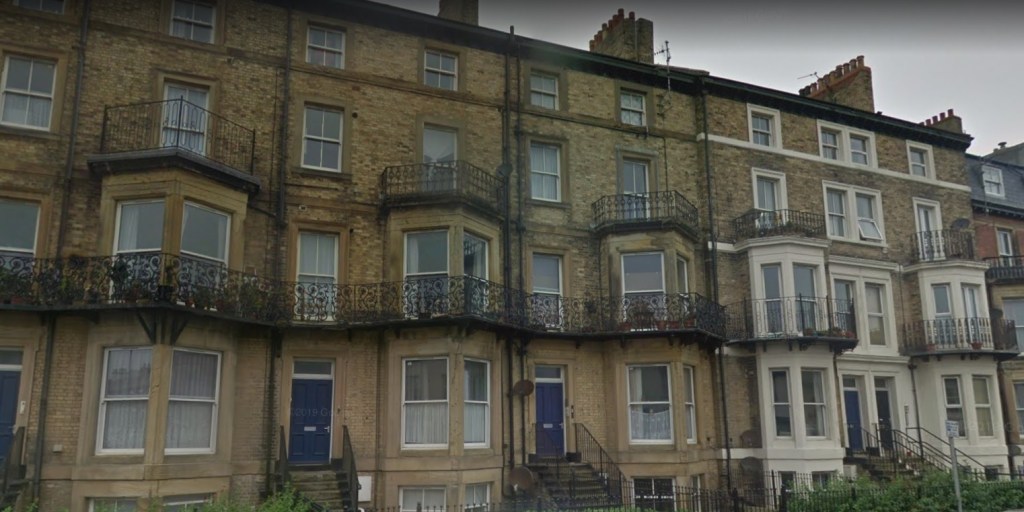
Ada was either already pregnant, or became pregnant immediately, and their first baby was born in Whitby on 4th August 1886. A second son followed on 6th May 1889. When the census was taken in 1891, Ada and John lived on the Esplanade at Whitby (now West Terrace, yards from Havelock Place):
They also owned a house at Ruswarp, called Turnerdale Hall:
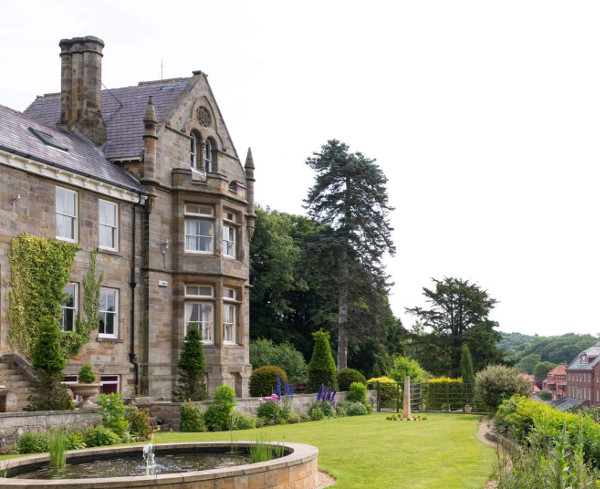
They also owned Woodleigh House, down the road from Aislaby Hall, which I cannot find a picture of: it’s still standing.
In August 1893, the pair separated. And in October 1893, John filed for a divorce, which shocked and delighted the newspapers.
A quick note on Victorian divorce law. Women were not permitted to divorce their husbands unless they could prove both cruelty and adultery, and even then were likely to become social pariahs. They usually also lost custody of their children. Men could divorce their wives for adultery alone, and tended to have the resources to do so: divorce was expensive.
So, on the 3rd October 1893, John filed for divorce on account of Ada’s adultery with two men: Charles James MacColla (a French-born solicitor), and Captain Percy Monson (a rather disreputable American with numerous aliases). Three weeks later, he added the name Robert Henry Garratt. Three days later, he agreed to pay Ada £7 10s a week to keep herself (about £3300 a week in today’s money). She was allowed to see her two little boys for four hours, once a month, at John’s home. In July, her monthly contact was suspended on account of her ‘molesting’ her husband and children. It’s unclear what was meant by this: perhaps she was hysterical, or tried to take the children away.
A flurry of affidavits, claims and counter-claims went between the solicitors of the two parties, and it wasn’t until November 1894 that the case came to court, and hit the newspapers. The divorce papers do not feature any subsidiary evidence, but there was plenty of it mentioned in the court papers, mostly generated by John’s family: intercepted letters that Ada had sent to her friends, testimony by John’s family and friends. However, I can only base this write-up on what I have been able to read myself.
Ada’s divorce was contested by Robert Garratt, one of the men accused of adultery with her. According to the newspapers, the marriage was happy until they met the Garratt family. The Garratts were family friends of the Harrowings, and the evidence of Ada and Robert’s adultery was chiefly based on John walking in on Ada alone with Robert once, and on Ada walking around Whitby with him. The affair was said to date from the summer of 1890. One man testified that he’d seen Ada and Robert go into the Harrowings’ house on the Esplanade when it was otherwise empty. Another man claimed he had seen Robert and Ada together in the woods, but it was strongly intimated that this was part of a blackmail attempt: “Anything would get to be a scandal in Whitby” said Robert. Robert’s wife testified that she did not believe he had committed adultery with Ada, but that John had forbidden Robert to enter the house. John’s sister, Helena, and an unnamed aunt testified that Ada and Robert had been alone together on several occasions. A cook called Jessie Wilkinson, who may have been related to John’s stepmother, also testified that Robert had been in the house when John was not. John claimed Ada had become a different woman after she met Robert Garratt, losing her ‘modesty and delicacy’ towards him.
Ada announced at Christmas 1890 that she was going to stay in London, and John had followed her and found her in a hotel – he suspected she had gone with Robert Garratt, but Robert was actually in Liverpool with his family. John then hired a private investigator to watch where Ada went. In 1891 or 1892, depending on source, she left again, and the investigator found her staying at Margate with Charles MacColla. The case against Percy Monson claimed that Ada had picked him up at Margate aquarium and promptly gone to stay at a hotel with him. In 1893, it was alleged that Ada and her sister, Helen Newton, had set themselves up as high-class prostitutes at Bedford Place in Bloomsbury. John also testified that Ada had falsely accused him of adultery and attacked him on more than one occasion.
The court found that Ada had committed adultery with both Charles MacColla and Robert Garratt, and Robert was ordered to pay John £300 in damages. The court did not find she had committed adultery with Percy Monson, although no reason was given for this discrepancy: perhaps the court did not think it feasible that Ada was a prostitute. Ada was ordered to pay the costs of the divorce. The courts later decided Ada did not have to pay all the costs on account of the cruelty she had suffered. By May 1895, Robert Garratt still hadn’t paid the money he’d been ordered to, and the divorce was not completed until July 1895.
It’s what the newspapers did not report that is of interest. They all made reference to Ada’s ‘counter allegations’ without elaborating on what they were. John was advised not to call Ada to give evidence at the divorce hearing, perhaps because they did not want her allegations to become public knowledge. John’s initial divorce statement claims that Ada committed adultery on 26th August 1893, in Greenwich and in early September in Margate, both with Charles MacColla. He claimed she had committed adultery with MacColla again in mid-September in London. In his first statement, MacColla was the only man he accused. He added accusations about Garratt and Monson later, after Ada had filed her counter-suit.
Ada’s rebuttal and counter-suit survive, and shed much light on their ‘happy’ marriage. In January 1886, when she was in early pregnancy and they had been married just two months, the couple were staying at John’s aunt’s house on Royal Crescent in Whitby. John came home drunk, pushed Ada over a chair. Later that evening, he physically kicked her out of bed, and Ada was ill for two weeks. This was the first of many occasions, she reported: he would kick her out of bed when drunk, not let her back in, and sometimes spit on her. When Ada left to go to London at Christmas 1890, she said John had thrown the contents of her bag all over the drive, grabbed her, and threatened to kill her. He then locked her in a room with him and his aunt, and wouldn’t let her out. Ada left John on this occasion, but in January 1891, he begged her to return, so she did.
A month after she returned, while saying her prayers at the bedside, she alleged John hit her around the head and shoulders, then woke up their eldest son (aged four) to tell the boy how his mother was wicked and ‘would for the devil’. Later that night, John kicked her out of bed again, leaving her bruised, pushed her from the room and locked her out.
In the spring of 1891, John grabbed her by the throat, forced her to her knees and nearly strangled her. At Christmas 1891, he threatened her with a revolver, and in January 1892, she left him again. She returned when he promised to behave better.
This time, things seemed to be better for a little longer. However, in September 1892, he threw Ada out of their bedroom by her neck, then threw her down the stairs.
In August 1893, around the time their marriage finally ended, and probably with proof from the private investigator that Ada had been seeing Charles MacColl, John called Ada a prostitute in front of their children and governess, then beat her about the head, pinned her to the floor with his knee and banged her head against the floor, and tried to strangle her again. He then threw her against the room into a wall, threatened to knock her brains out, and then kicked her over a chair. Ada was visibly battered and bloody from this assault, and left her husband a final time on this occasion.
Ada claimed her husband frequently called her a prostitute in front of her children (who were seven and four when the divorce proceedings began), encouraged the children to call her a prostitute, and told them not to obey her. She also claimed that her husband committed adultery with a woman named Jenny Atkinson on his boat, moored at Whitby, and at Turnerdale Hall.
John denied adultery. He did not deny that he had hit his wife, only that he had never been ‘excessive’, except ‘in self defence’. In court, he claimed Ada had attacked him – he went to some lengths to paint her as a hysterical prostitute.
John was a jealous husband: he admitted in court that he was jealous of Robert Garratt, and also of Ada spending time with her sister Helen. The fact that he was so violent towards Ada in their bedroom, and constantly called her a prostitute, long before he claimed to suspect her of adultery, suggests he experienced violent sexual jealousy and possessiveness of his wife. There is an undertone of sexual violence throughout Ada’s affidavit- although marital rape was unrecognised, many of their arguments occurred in the bedroom and strangulation is a frequent feature in rape and serious domestic violence cases.
Ada’s whereabouts before their marriage aren’t known, and her sister Helen certainly moved around London living with men she wasn’t married to, so it’s not impossible that Ada had been a ‘kept woman’ before she married John.
So the marriage ended. John returned to Whitby with his two sons. In 1897, he remarried. His second wife was his maternal cousin, Jane Ann Tesseyman, the daughter of his uncle William. Jane was born a year after John’s mother died, and was named after her. John and Jane appear to have been happily married: they had four children, and lived in Ruswarp. John inherited a vast fortune when his father, Robert, died in 1900. Robert left well over a million pounds, worth somewhere between fifty-five and eighty-eight million today.
John was knighted in 1921:

Whole-Plate nitrate negative, 7 July 1926 National Portrait Gallery x69096. Used under Creative Commons license
He died in 1937. His second wife, Jane, died in 1961, in her nineties.
Ada is completely untraceable after their divorce. She may have changed her name, or gone abroad. Robert Garratt is also untraceable. Charles James MacColl died in 1919. Percy Monson is untraceable, and presumably went back to the US, to continue to be disreputable and mysterious.
Neither of their sons had a happy ending. The younger, John, was killed in action in 1917, aged twenty-eight. The elder, Robert, suffered a head injury in the First World War, and shot himself in the head in 1932, when he was forty-five.
- I am grateful to Estella Harrowing and Jo for their information on the location of Aislaby Hall: the photo that previously featured on this blog was of a different Aislaby Hall, close to Pickering.
- Money conversions done using http://www.measuringworth.com
 Sophie Michell