
Recently, I’ve been working through local inquests from 1887, which involves a lot of newspaper reading. Local newspapers reported national and international news, so there’s been many interesting stories: Queen Victoria’s Golden Jubilee preparations and celebration echoing the current Platinum Jubilee, the push to get Katherine of Aragon a proper memorial in Peterborough Cathedral, the concerns about water quality in Stanground and Werrington.
But one story really grabbed me. A story that seemed too fantastic to be true. A story I assumed the papers had luridly distorted. The story of George Grice.
On Saturday 27th August 1887, Catherine Scraggs was travelling in a third class carriage on her way home from Stoke on Trent to Shrewsbury. Catherine was a woman of impeccable character, a teacher at St Mary’s board school in Shrewsbury. Other people had travelled in her compartment and left the train at Wellington. At the time, railway carriages did not have internal corridors. You entered your compartment from the platform, and there you stayed until you arrived. This made them rather dangerous for ladies travelling alone.
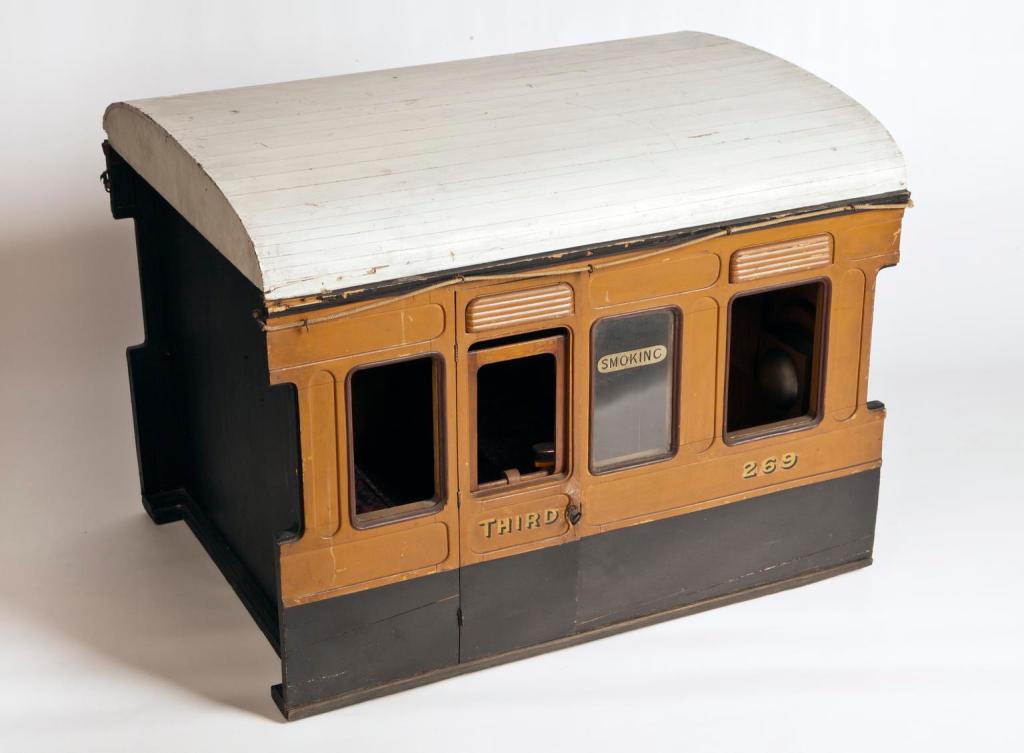
The tickets were checked at Wellington, and just before the train departed, a man joined her in her compartment. Catherine was reading a magazine, and appears to have paid little attention to the man in the carriage at first.
As soon as the train left the station, he moved to sit next to her. He asked her a question, said something about his wife in Shrewsbury, then put his arm around her. She asked him to get off, and said she would call for help.
So he smashed her in the face, and started ripping her dress. He tried to force her down, but she managed to resist him. They struggled to the window, his hands around her throat. The window was open, so she reached through and got the door open. Grice then tried to push her out of the door, and when this failed, he slammed the door on her arm. Catherine held on for dear life, screaming bloody murder. Grice laid down to unbutton his trousers.
In the smoking compartment next door, Alexander Graham and another gentleman were enjoying the ride to Shrewsbury. Alexander was about twenty-six, and recently passed the bar exam. He’d taken a job at Shrewsbury as a barrister. He was unmarried. He heard Catherine screaming and put his head out of the window. He screamed at her not to jump, and grabbed hold of her free arm. He drew her through the door and into his own carriage, along the footboard. A footboard is a narrow platform that runs around the carriage: it’s not wide enough to stand on properly. The train was travelling on the main line, at 30 to 40mph. Other trains would have passed them – Shrewsbury is a busy interchange. To move along the carriage in this way was suicidal, but infinitely preferable to being left with the homicidal rapist.
Mr Graham pulled Catherine in through the window. And Grice, perhaps assuming she was simply going to another empty compartment, followed her. Imagine Catherine’s horror when his face appeared at the window.
Well, Mr Graham was a gentleman, and clearly neither shy nor retiring. He carried a concealed sword in a cane, drew his weapon and thrust it into Grice’s face. Grice withdrew, but stayed at the window, staring for a minute or two.
As the train passed Abbey Foregate station, Grice jumped off the side of the train, presumably thinking he would escape. However, he evidently hadn’t reckoned with the speed the train was travelling at. He landed, ran forward with the momentum and fell against the end of the platform, knocking himself out. He was removed to the infirmary shortly afterwards.
Catherine was badly bruised, and terribly shaken, but thankfully not badly hurt. Her nose had evidently bled profusely: the carriage was smothered in blood. She went to hospital to recover from the shock, but apparently made a full recovery and was able to give evidence a month later.
Grice recovered, and as he recovered, some very strange stories began to circulate in the local press. He was born in 1854 in Bradwell, and his birth surname was Grace. He moved to Tipton with his parents in the 1870s. He worked as an iron puddler, but couldn’t hold a job. And, he was supposed to be dead.
In early May 1887, a body was found suffocated on a spoil heap in Abercarn in Wales. A woman in a lodging house identified the body as Grice – then known as George Grace. An inquest followed, his parents were informed, and the body was buried. Two weeks later, Grice turned up at home in Tipton, furious that he’d been reported dead. Where had he been? Who was the body in the grave? Nobody seemed too invested in finding out.
In June 1887, still in Newport, he was arrested for a drunken assault. Between June and August, he made his way back to Tipton.
Grice’s background was full of deceit. He’d joined the army in 1877 and served in India. He was discharged in 1879 for lunacy. In 1879, soon after being discharged from the army, he raped Sarah Coggins, a 55 year old woman. His modus operandi was the same as with Catherine – he asked her directions, waited until they were out of sight and then punched her in the face. He had held her by the throat during the assault. However, the magistrates did not consider there to be enough evidence to convict, and acquitted him. Around this time, he impregnated Ann Edge, although it’s unclear whether this was consensual or not.
He re-enlisted as George Grace in January 1881, and was discharged. He enlisted again four months later as George Edge, using his girlfriend’s surname. Once again, he was discharged and re-enlisted under another false name – George Emmerton, his mother’s maiden name – for a fourth time in 1883. His army medical records note a diagnosis of imbecility and syphillis.
It’s unclear whether Grice’s head injury on the railway platform exacerbated his madness. He appeared in the magistrate’s court in late September, and told them he couldn’t remember anything. He was remanded to the Assizes in November, and found unfit to plead on account of lunacy. He was sentenced to be held at Her Majesty’s Pleasure and made his way to Broadmoor. He spent the rest of his life there, dying in 1934, aged eighty.
Alexander Graham remained in Shrewsbury working as a lawyer. I cannot trace Catherine Scraggs – if this was fiction, she’d have married Alexander, but alas, it was not to be.
SOURCES: Dudley Herald, 1st Nov 1879, Star of Gwent, 13th and 27th May 1887, 17th June 1887 and Wellington Journal and Eddowes Shrewsbury Journal, August-November 1887.
Get in touch with your own family research problems and questions using the contact page above.
 Sophie Michell