
Barnsley Bangers

In honour of Diwali and Bonfire Night, my favourite time of year, here’s a story about what happens when fireworks go wrong.

Barnsley, 1868. George Norris, aged thirty-five, was a man who provided luxuries: he was a jeweller, hairdresser, perfumer and he also had a small firework factory on the Doncaster Road, between the Wesleyan School and the Calvinist graveyard. The factory opened in 1865.
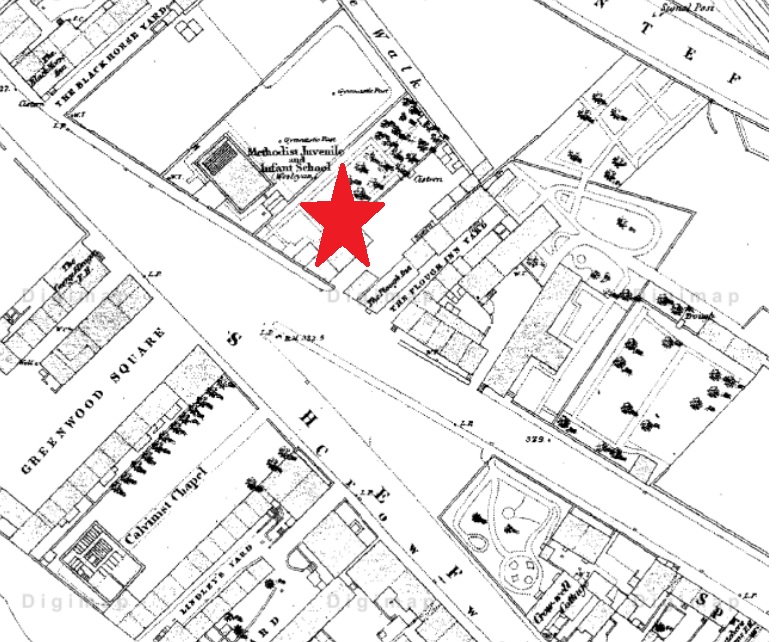
Image courtesy of Digimap. Barnsley 1856 Town Plan OS map.

The factory was not purpose built, and consisted of a few sheds. George lived nearby in Sheffield Street, with his friend and co-worker Alfred Banks. He employed people from the local area, a network of courts and lanes around Taylor Row and Union Street. In October 1868, he had a staff of fifteen, and one assumes they were preparing for Guy Fawke’s Night. Most of the staff were working eighteen hour days to fulfil orders.

Work began as usual on 7th October, around 7am. George Norris was on site that morning, as was his foreman, William Elliott Bywater. The main working shed was long and narrow. It had one door, and at the other end, a stove. The stove was surrounded by iron bars, with one used to dry out powder that had got wet. The powder was usually dried in its separate components.

Maria Cooper was thirty-five. She’d worked in fireworks factories for years, and finished her shift the night before at 11pm. That morning, she was trying to fill Catherine wheels with composite – saltpetre, charcoal and sulphur, otherwise known as gunpowder – but the composite was wet. So, she placed a paper box of composite on the stove, with an offhand comment that she didn’t care if it blew up: she was in a hurry.

It seems Maria was in the habit of putting composite in tins on the stove to dry. Perhaps this was safer – I’m not about to experiment to find out. George Norris and his foreman, William Bywater, saw the paper box on the stove and simultaneously ran towards it to get it off.

They were too late.

The explosion threw William Bywater out of a window. The fire spread across the site, which was full of combustible material. Fireworks screamed into the air, exploding merrily over the carnage. Locals ran to the site, trying desperately to rescue the workers, and no water hose was found for over an hour. Meanwhile, the workers burned and died, tended to by their families and neighbours in nearby stables.

You see, there were no less than nine children among the thirteen workers. Two of them – Joseph John Siddons, aged ten, and Tommy Carrol, aged thirteen, survived. Six of the others died at the scene. Nine year old George Yates had only started work two days before. His father found him dying, screaming for water. Poor John Watson, aged eleven, had been at work for two weeks. He was trapped by flames in the corner of the factory shed. A stick was pushed through the flames to pull him out, but the skin on John’s hands came away on the stick, and the fire consumed him. Sarah Downing’s father had died a few years before, and she told her mother that she would “soon be with father”.

One child, Harriet Hinchliffe, an orphan who had been working in the factory since she was eleven, died in the workhouse the next day.

Maria Cooper was killed outright. Three other men died two days later. Richard Evans, aged nineteen, had lost his sister in the initial explosion. Both the Evans’ siblings lived with George Norris. George Norris also died, having never regained consciousness. William Bywater managed to give a statement to the police before he died. His statement ended: “I don’t think I shall get better. I have no feeling in my hands. I cannot write.”

There were four separate inquests after the fires were put out. The first was for the seven people who died at the scene, held at the Union Inn at the end of Union Street. This was held on the afternoon of the accident. Another was held on the 9th for Harriet Hinchcliffe, who died in the workhouse. The coroner returned to the Union Inn to cover the deaths of Richard, George Norris and William Bywater. A final inquest was held on the 13th October at the courthouse in Barnsley, after the firework factory had been inspected.

The inspection was damning. Ideally, the firework factory should have been a collection of small sheds, with no more than two people working in each one. At Norris’ factory, the entire workforce were in one shed. There was gunpowder everywhere, all over the floors. None of the sheds were suitable for storing or managing combustible material. The ventilation and exits in the work shed were inadequate.

However, the inquest jury decided to bring a verdict of nine counts of manslaughter against Maria Cooper, whose foolish, overtired, probably stroppy action had caused the death of so many. Maria’s own death was ruled death by misadventure. The jury added a rider: “[…]children of such tender years ought not to be employed in such dangerous occupations and […] there appear to have been no proper regulations in conducting the works and that the sheds were unfit for carrying on such business”. At the time, it was illegal to employ children aged under nine, so George Norris was legally employing these kids, although it’s likely that they were working longer hours than allowed in law.

Most of the dead were buried on the 9th and 11th of October, and their funerals were funded by George Norris’ estate. However, his estate refused to pay the medical costs of the survivors or to support the victims’ families, a very unpopular move in the town. Some fireworks manufacturers in London sent some money over for the victims, which was gratefully recieved.

I found this story years ago, while looking through the coroner’s notebooks for West Yorkshire. It stuck in the mind because the inquest blamed the only woman in the factory for the deaths, rather than the myriad problems with working conditions that led to an accident becoming a massacre. I hadn’t realised how young the children were.

Remember them.

Mary Ann Evans (1852-1868)

Jane Hawker (1854-1868)

Henry Howarth (1856-1868)

Sarah Ann Downing (1856-1868)

Harriet Ann Hinchliffe (1855-1868)

John Edward Watson (1857-1868)

George Yates (1859-1868)

SOURCES: West Yorkshire County Coroner’s Notebooks, Ancestry and the Barnsley Independent.

Get in touch with your own family research problems and questions using the contact page above.
EVENT!

I’m very pleased to announce that I’ll be doing an online talk for Ripon Museums on 28th October 2021 at 7pm, about nineteenth century murder investigation.

I’m really excited about this: it feels like YEARS since I last did a talk, and I’ve really missed telling people about horrid deaths. I’ll be covering two grisly Victorian murders from the Ripon area.

The event is ticketed, and you can buy your tickets here.

The Ampthill Workhouse Riot

Before we begin, it may be useful to refresh yourself on the Poor Law. For now, it’s enough to say that welfare was reformed in 1834, and rather than being organised by the parish, it was organised by a conglomerate of parishes, known as a Union. The Union was administrated by the Board of Guardians, a collection of local dignitaries, and relief was given to the poor through Relief Officers. The poor had to find their local relief officer and put their case forward for welfare. In the early days of the new workhouses, the Board were told that if the father of a family needed to go into the workhouse, the whole family should go in. It was a punitive system. It was…unpopular.

In Bedfordshire in the 1830s, one of the major occupations was lacemaking. Everyone made lace. Men, women and children, in family groups, spent their entire lives hunched over a pillow, losing their eyesight, ruining their backs. In the 1820s, the bobbinet machine was developed in Nottingham, plunging lacemakers into poverty as their work became virtually worthless. Lace adapted – Bedfordshire lacemakers started using different methods that machinery couldn’t copy – but never really recovered.

Philip Ashwell was born in Kempston on 19th December 1798. He married, and had a brood of children, and they moved to Lidlington. He may have worked on the land, he may have been a lacemaker. By the mid-1830s, he was listed as a labourer. His wife and children made lace as soon as they were old enough – three was the usual age to begin lacemaking and lace schools popped up all over to teach the children lacemaking.

Philip appears to have been a man with a sense of injustice – in 1829, he was fined for smashing up wheelbarrows belonging to the parish relieving officer, for reasons I have been unable to determine. However, the timing and the target suggests Philip had an issue with how poor relief was being doled out to suddenly impoverished men.

Ampthill Union was formed in April 1835, pulling together nineteen parishes under one umbrella of welfare. Philip Ashwell, his wife Ann, and their six children were living in Lidlington. On 11th May 1835, the newly appointed Relieving Officer rode to Lidlington to take a register of paupers and meet with the overseer – an induction day, if you will.

History is written by the victors, or in this case, the entire governing class. The local magistrates, clergy and the parish constable told this story in the press, not Philip. Philip’s version may have been quite different, but we don’t have it. So, here’s the version that comes to us through the newspapers. The Relieving Officer, a Mr Osborne, arrived in Lidlington, and was met by a group of furious women. Mary Walker, Amelia Gulliver, Hannah Reed and Elizabeth Henman told him that “We don’t want you here. We want money or blood“. Apparently they told him that they’d have the money out of the pockets or the blood out of his veins. Mr Osborne told them he had no money, but on having his life threatened, he gave the assembly the money he had in his pocket.

The next day, a Tuesday, Mr Osborne travelled to Millbrook, three miles east of Lidlington. He recieved a more terrifying reception here, and was forced to hide at Reverend Cardale’s house. Reverend Cardale was a magistrate, and attempted to disperse the crowd using force of personality and threats alone. Mr Osborne, Reverend Cardale and Cardale’s son attempted to escape Millbrook, and were chased. They hid in a house until it was dark, and then escaped.

On Wednesday, a group of constables went to Lidlington to arrest the women already mentioned, and were met by two hundred paupers. The village’s total adult male population was less than two hundred in 1831, so this represented a considerable chunk of the locals. The constables were outfaced and outnumbered, and left without arresting anyone.

The local government tried to muster a stronger police force, by conscripting special constables. But the local men were having none of it, and most preferred to pay the fine for refusal than sign up to try and break this disturbance up.

Thursday. The Guardians were due to meet at midday at Ampthill House of Industry, the precursor to the union workhouse, which was under construction and not completed until 1836.

They’d barely got down to business when the mob assembled at the front of the building. Depending on source, there were up to five hundred people there, including children. The men were armed with sticks. They demanded money rather than food/fuel in relief. When they were told this was impossible, they attacked the building, smashing the windows with stones, bricks, sticks and er…cabbage stalks.

At 1:30pm. Mr Musgrave, a magistrate and the head of the Board of Guardians, read the riot act. This was no turn of phrase – once the Riot Act was read, the mob had an hour to disperse, on pain of death. Mr Musgrave was taking no chances – he moved among the mob, reading the Act twice, to make sure everyone heard it. And then he hid back in the House of Industry and waited.

Some of the mob did disperse. The power of the law would have been well known to many of the labourers in the crowds, who had spent time in prison or seen family transported for breaching game laws or theft. However, in general, things deteriorated. The mob moved to the Market Place and there were straight-up fights between the mob and the special constables that had been drafted in to control the disturbance. Mr Adey, another member of the Board, left Ampthill at this time and went to London, presumably by stagecoach as there was no railway line at this early stage. He went to request government assistance.

Earlier that morning, the auditor of the Union, Mr Graeme, had also travelled to London to request Metropolitan Police aid. The Metropolitan Police were formed in 1829, and used across the country as riot police. Twenty-two Met policemen, some mounted, arrived in Ampthill on Friday morning to break the disturbance up – an astonishingly speedy response.

The riot had mostly dissipated by this point – it’s hungry work, walking and yelling all over Bedfordshire for several days, particuarly if you have children with you and you’re living on subsistence earnings. The summary trial of the women above happened on Friday afternoon, once they’d been rounded up by the Met. Five men were also arrested and tried at the same time. All were sent for Assize trial, along with some other men who were caught in the subsequent days. All of them were tried just over a month later. The women were sentenced to three months in prison each. The twelve men who were tried in June 1835 were sentenced to between six and twelve months in prison.

But what about Philip Ashwell? He wasn’t arrested in the first crop of prisoners. In fact, I suspect he ran away and hid. He was not arrested until September 24th, and he was arrested in Langford, some sixteen miles from Lidlington and in another Union. God knows where this left his pregnant wife and six children…

Philip, and his co-accused James Sherwood, were held in Bedford old gaol for six months before trial. James was accused of smashing windows and lingering after the riot act had been read. Philip was pointed out as one of the ringleaders in the riot – his earlier conviction for smashing up wheelbarrows suggests that he was known to the magistrates and that he was a reasonably likely candidate to be the ringleader.

On 10th March 1836, Philip stood trial at the Lent Assize, was found guilty and sentenced to death.

A couple of weeks later, his sentence was commuted to two years in prison. He spent his sentence in Bedford Old Gaol. However, the end result was the same – he died on 19th January 1837, probably from a gaol fever. His youngest son died a few days later on his first birthday.

His wife Ann remained in Lidlington. She gave birth to another child in 1841, after having two of her sons die in quick succession. As a widow with an illegitmate child, she was theoretically barred from poor relief, but the records show that she claimed relief for her dying daughter Abiatha for several years. Abiatha died in 1844, aged twenty-one. Ann later remarried, and died in the 1870s.

When this story is told today, the usual reason given for the violence is that the paupers wanted to be given their welfare in cash, rather than in food or fuel, an innovation of the New Poor Law. Having read the source material, it seems that this disturbance originated with women. Previously, the wives of pauper labourers had been generally supported at home. Now, they were at risk of being incarcerated, separated from their homes, support systems and their children, every time money was scarce. And money was scarce – Lidlington was described as having a ‘surplus of labour’, possibly redundant lacemakers, but there was no effort to find these men work that didn’t dilute the wages of other labourers. This fight started with angry, powerless women, and once the momentum was gathered, it terrified the powerful.

I came to this story through Philip’s son, Zachariah. He was coming up for nine when all this happened. He moved away from Lidlington after his father died, probably to work in farm service, and eventually found his way to the fens around Thorney. He married there, and spent his life farming on Whaplode Drove. There is a small, but interesting detail in his life that perhaps gives a hint to how the Ashwells felt about their rioting father. Zachariah and his wife had at least thirteen children, although only six reached adulthood. His children were named after himself, his wife, his dead brother, his mother, his dead sister.

But not one was named Philip.

SOURCES

‘Serious Riots in Bedfordshire – The New Poor Law Bill’, The Times of London, 19th May 1835, p.5

‘Bedford Assizes’, Northampton Mercury, 26th March 1836, p.4.

Bedford Gaol Register and other parish records

Talking About Death

I recently took part in the excellent Telling Small Stories, Telling Big Stories, a symposium about family history organised by Dr Julia Laite.

This conference was recorded, and I’d really recommend catching up with it. I spoke on Panel 1, and my talk starts at 30 minutes, but all the speakers were amazing.

I was really delighted to take part, and share some of my research. I’ve met loads of new people and made new friends. It was a kind, gentle and generous event, and I’m so grateful to Julia for giving me the opportunity to speak.

You can find the videos of the event here.

Telling Small Stories, Telling Big Stories

Next month, Historians Collaborate are hosting a two-day online workshop on the intersection of family history and academic history, and I’ll be speaking at the first session on 16th June.

I’m quite nervous, and very excited! I’m also really looking forward to watching everyone else’s presentations!

The event is free, but you’ll need to book to get access on the day. You can book here.

Maybe I’ll see you there!

Birthday Post!

Can you believe it’s been two years since I started this little venture?

The last year has been…bizarre, in so many ways. A whole year in and out of lockdown, home-schooling more often than not. I started my PhD in October and although I’m a part-time student at the moment, I seem to think about little else.

I decided to stop taking on full trees last year, because they take up time, and I could no longer promise to deliver within four to six weeks. Despite that, in the last year, I’ve done:

Eight (and a half) full trees

Eight searches of varying degrees of complexity

Three house histories

Three mini-jobs of varying types

Over 250,000 words

One talk!

Blog posts on bigamy, throwing statues in the sea, child neglect, community cover-ups, grief, historic rape, domestic violence, infanticide and male violence.

1700 tweets @SophieMHistory

THREE TERMS of home-schooling!!

And most importantly, ONE SIXTEENTH OF MY PHD LIT REVIEW

The kids are back in school, I’m getting into a research rhythm and I’m hoping to take more work on soon. In the mean time, I’m always available for little jobs and searches (see my services page for more).

Thank you for your custom, if you’ve bought anything this year, and for your support. ❤ ❤

Stay Inside

CONTENT WARNING: Rape, murder, sexual abuse, DV, the works.

CONTENT REMINDER: This is focused on men hurting women, because that’s the current news focus. I know women can be domestic abusers, I know of Denis Nilsen, I know that transwomen are even more at risk of being murdered than ciswomen. If you want to write those stories, please do!!

I’m a crime historian, specifically researching the investigation of Victorian murder, and I have spent whole YEARS of my life thinking about, reading about, writing about horrific crimes. The psychology, the investigation, the details, in history and in modernity. So, as you can imagine, I have many thoughts about the disappearance of Sarah Everard.

Abduction, rape and murder by a stranger is a really rare crime. That’s why it tends to get a lot of headlines. On the one hand, we should be glad that this is unusual. On the other, it tends to spark waves of debate when it does happen. If you’re on twitter, you’ll have noticed a lot of women talking about the discourse around keeping yourself safe at night, and about the unwanted attacks and harassement they’ve experienced, at any time of day.

Sarah Everard did everything you’re supposed to, as a woman walking in the evening. She texted her boyfriend, she walked in a well-lit area, on a busy street. She was abducted anyway, allegedly by a policeman. Women are taught to go to the police for help. Everyone is taught to obey the police.

Nevertheless, the initial reaction was for women to stay inside, a sad echo of the advice given in Yorkshire when Peter Sutcliffe stopped killing prostitutes and started killing women who were ALLOWED to be victims. 

Most women have been harassed by a stranger at some point in their life. I can count several occasions where men have outright assaulted me, and literally DOZENS of occasions where I have been wary and uncomfortable. Some of these are minor – what woman hasn’t had to carefully escape the persistant guy in the bar who won’t take no for an answer? Some are more severe – the guy who stalked me after I made him a cup of tea at work. And the assaults are just grim, not least because I was in my early teens when most of them happened. 

Being raped or murdered by a stranger is really rare – you’re far more likely to be killed by a partner than a stranger. Staying in to protect yourself from being murdered by a random might even lead to you being murdered by your partner. 

But. Harassment by strangers is not. Harassment by strangers is commonplace. From a yelled comment out of a van window, a flirtation swinging to abuse when you say no to a drink or a date, to being flashed, to being followed, to being groped on the tube. 

Here’s the problem though. Every single man who has raped and murdered a woman he doesn’t know has a history of abusing women. The women are sometimes painted as ‘lucky ones’, the ‘one who got away’, and it’s a tale as old as time. Ted Bundy admitted attempting to abduct women several years before killing the first. Peter Sutcliffe attacked his first victim six years before his first known murder. Robert Black sexually abused children from childhood, as did Frederick West. In 1972, Caroline Owens escaped from the West house after suffering sustained abuse: the Wests were fined £50 and murdered eight women in the following few years. John Duffy, who raped numerous women and killed three in the 1980s, had a history of raping and assaulting his wife, and joked about rape being a ‘natural male instinct’. Ian Huntley beat his wife until she miscarried, and was not charged by the police after two separate accusations of rape. 

The cat-calls, the dodgy jokes, the yelled insult after a rejection, the groping, the refusing to take no for an answer, the flashing: all either low-level crimes or not criminal at all. Domestic violence, which is a common behaviour in terrorists, rapists, murderers and mass-murderers, is STILL not treated as a serious crime, until someone dies (and even then, sometimes totally ignored). 

Women should be able to go outside at night without fear, but women have no handy test to work out if the man cat-calling them is a drunk idiot or a murderer. There’s no way of knowing whether the guy running up behind you is literally jogging home or about to strangle you off the pavement. 

This is compounded by the fact that SO MUCH violence against women is structually and institutionally ignored. When men are allowed to broadcast their misogyny without being held to account, when they are allowed to test out their sexual fantasies by groping women and flashing them, when the police set them free after they’ve beaten their partner again, then they become emboldened. They escalate. Abducting, raping and murdering a stranger is not an impulsive event; it is planned.

We have to start cutting it off before it escalates. We have to start taking violence against women seriously.

The Datchet Baby Murder

Last night, I wrote up the sad story of Louisa Atkin, who died following a botched abortion in 1873, on Twitter (you can find it here). Today, I want to tell you another, longer tale, of what could happen when abortion failed. Obvious content warnings for pregnancy, abortion, infanticide and coercive control.

Annie Harris was born in early 1873 at Ducklington in Oxfordshire. She was the daughter of an agricultural labourer, and grew up at New House Farm in Aston. She was small, only 4ft 10ins, with brown eyes and brown hair. In 1891, she met Albert Coombs, and they married at Witney Baptist chapel in February 1892, shortly before she turned nineteen. Their daughter was born at the end of the year, but she was their only child.

The marriage was unhappy. In November 1895, Annie had her daughter baptised into the Church of England, and then left Aston. Her parents took her daughter in, and Albert moved to Brentford. Annie went to work as a barmaid in Colnbrook, a few miles from Windsor.

Annie probably moved there because she already knew Benjamin Hopkins. He was born in 1864, the son of a butcher and inkeeper – his father had formerly ran the historic Ostrich pub. He’d married Kate Hambleton in 1886, but they separated in 1890 – Benjamin was chronically adulterous, and had impregnated a young servant in Colnbrook. He had to pay maintenance for both his two legitimate children plus his illegitimate daughter. His parents had also separated, and by 1891, he was living with his mother on Colnbrook High Street. His father, also named Benjamin, drowned in a gravel pit in 1895.

Annie and Benjamin began a relationship almost as soon as Annie arrived in Colnbrook, and by the end of March 1896, she was pregnant. Both parties were married, there was unlikely to be a happy ending. The story that follows was told openly by Annie, when she chose to cross-examine Benjamin in the coroner’s court. This was an unsual move, and scandalised the local press, but as with the case of Louisa Atkin and her mother’s evidence in court, means we have a much fuller story of what happened, and what reproductive choice looked like in the late Victorian era.

Annie became pregnant in early March 1896.

In April, Benjamin took Annie to the Pack Horse Hotel in Staines, and gave her half a pint of hot gin. It didn’t work.

In July 1896, Annie told Benjamin she was still pregnant. He took her to a chemist in Staines to buy some abortifacient medication – these were available under the title “obstruction removers”, but unreliable and worked (if they worked at all) by poisoning the pregnant woman. It appears that Benjamin asked the chemist to make up a recipe of his own to give Annie – the inquest didn’t record what was in the medication, or whether Annie took it. The inquest also didn’t enquire how Benjamin had developed his recipe.

Time passed, Annie’s pregnancy continued. Benjamin was beginning to despair. He asked her to have a surgical abortion, and she refused because she was too frightened – the story of Louisa Atkin suggests these fears were well founded.

He begged her not to go into the workhouse to deliver the baby – if she did, the Board of Guardians would enquire about the baby’s paternity, and sue him for maintenance, as had happened in 1892. The week before the birth, Benjamin asked Annie to employ a midwife called Mrs Taylor, who would strangle the baby at birth. This was a step that Annie was not prepared to take.

She did, however, agree to have the baby privately, with a family named Carpenter. Unexpectedly, the Carpenters had to leave Windsor, and Annie then applied for an order to go to the workhouse. Time ran out, and although the Board of Guardians sent a doctor to deliver the baby, Annie gave birth while staying with a nurse who knew the Carpenters.

The baby, a boy, was born on 12th December 1896 in Windsor. Annie and her son stayed at the house in Windsor until 4th January, and according to the nurse, Annie seemed fond of the baby, breastfeeding him and cuddling him. The nurse also noticed that Annie was using baby linen that she had for her daughter’s birth: she was prepared for his arrival.

On 4th January, Annie told the nurse she was leaving to go to visit a family called Hester, who were related to the Carpenters. Apparently, she was hoping they would take her baby boy in so she could return to work in service. According to her evidence, she had run out of money, had nothing to eat or drink for several days and the nurse had asked her to leave. She walked to Colnbrook to find Benjamin, so he could give her some money. She got as far as the bridge over the river at Datchet, and sat down to rest. The baby began to cry. She tied a scarf around his neck to quiet him. He died. This was Annie’s story.

Annie panicked. She wrapped up the baby with his things and went to find Benjamin. He got her a hot drink, and they appear to have spent the night together. The next morning, Benjamin paid for her train fare to visit the Hester family- Benjamin claimed to be ignorant to the fact the baby was dead. Annie spent the night of the 5th at the Hester’s house, telling them the baby was at Windsor, and then returned to Colnbrook on the 6th.

In fact, the baby’s body had been thrown over a fence in Datchet, landing in the garden of Leigh House, on the night of the 4th of January. It was discovered on the 5th, but it took the police a few days to round up Annie and Benjamin. Annie was arrested on suspicion of murder. The inquest was held on the 9th January, and found that the child, who was never named, had been murdered by Annie. She was sent to the Assizes.

Annie appeared in court on 30th January 1897. The charge was reduced to manslaughter, but she was found guilty and sentenced to seven years penal servitude. Her husband, Albert Coombs, applied for a divorce five months later, but the divorce was not completed until two years after Annie was released from prison. He remarried as soon as he was legally free to do so. Their daughter, Elsie May Coombs, died in 1901, aged eight.

Benjamin was not charged with anything. In the early 1900s, he reunited with his wife, Kate, and they moved to Portsmouth. There is a troubling postscript to their family story. When Benjamin and Kate separated in 1890, Kate was pregnant. Their daughter was paralysed, and died in 1911 when she was nineteen. Perhaps she had polio, but considering what we know about how Benjamin coped with unwanted pregnancies, her paralysis could have have been due to the effects of Benjamin’s DIY abortifacient medications.

Annie is untraceable after her release from prison in October 1901. Her divorce was finalised at the end of 1903, when she was still only thirty, so she may well have remarried.

The case of Annie Coombs has a terrible ending, not altogether satisfactorily answered by the evidence given in court. Did she really just strangle the baby in a fit of exhausted desperation, or did Benjamin have more to do with it? Why wasn’t he charged with concealing the body – something he is much more likely to have done than Annie? The baby was killed on the first day that Annie was alone with him, but it was also the first opportunity that Benjamin had to see the baby. He was determined to destroy the baby before it was born, right up to the last days before the birth, so why not afterwards?

SOURCES: The usual parish/census/divorce records. Windsor and Eton Express, 16th January 1897, Bucks Herald, 8th February 1897

The Divorcé

TW: Domestic violence, rape, suicide

My cousin, Linden Secker, is the head of biographical research at Holbeach Cemetery in Lincolnshire, and digs up stories about the people whose graves he looks after. Just before Christmas, he wrote about the sad suicide of Arthur Marriott, a divorced man who took prussic acid in a veterinary surgery in Holbeach. I am like a bloodhound when it comes to suspicious deaths that hint at marital woe, so I did some additional digging, and between us, the full story emerged. A story of perversion, abuse, terror and shame.

Arthur Marriott was born in Milton Malsor, a village a little south of Northampton, in the summer of 1866. He was the youngest child of Thomas and Mary Ann Marriott. His father was a Baptist minister, and Mary Ann was his second wife: they married in 1850, when Thomas was sixty-one, and Mary Ann was twenty-one. Despite the age gap, the marriage produced nine children, and Thomas was seventy-seven when his youngest child was born.

Perhaps inevitably, he died when Arthur was still young, in 1876. Thomas did not leave a fortune, but Arthur was sent to boarding school in Northampton. His mother didn’t remarry. She moved to Kettering, and Arthur moved in with her after he finished school. They lived on Silver Street, and Arthur worked as a veterinary surgeon, along with his older brother, Samuel James Marriott.

Eliza Jane Collier was born in Northampton in late 1864. Her father, Simon, was a shoe manufacturer in the town and they were affluent. It is unclear how she came to meet Arthur Marriott, but they married in Duston parish church on 8th September 1887. Arthur was twenty-one, and Eliza was almost twenty-three.

Their daughter was born almost exactly nine months after the marriage, and a son was born in January 1891. However, the marriage had already ended when little Harry was born, and Eliza had returned to her father’s house in Northampton. Arthur had gone to live with his mother in Milton. He later moved back to Kettering, living at Montagu House, at the junction of Montagu Street and Newland Street.

Eliza did not file for divorce until January 1893, a month after catching her husband in bed with another woman, Emma Walker. As I have mentioned before, divorce law was extraordinarily sexist and divorce was expensive. Men had to prove adultery against their wives to gain a divorce, and women had to prove cruelty and adultery, hence Eliza having to wait until she had proof of adultery – Eliza’s father had also been present when Arthur and Emma were found in bed together, to corroborate her story. Eliza had waited two years for this evidence, suggesting that Arthur had taken care to conceal his relationships, perhaps to avoid the stigma of divorce.

Eliza’s divorce petition makes for horrific reading. The petition opened with a description of their marriage and children, and two different adulterous relationships that he had had with Emma, and Annie Smith.

Then came the cruelty. Men were allowed to chastise their wives within reason, and reasonable chastisement was an extraodinarily flexible concept. However, no court could have found Arthur’s treatment reasonable, considering the family’s class. He had used foul language many times, used obscene language, had shoved her, threatened her, dragged her down the stairs. In November 1890, when she was heavily pregnant, he had driven Eliza ‘furiously’ through Kettering in a carriage and then pushed her out of it. He then threatened to whip her. He was drunk at the time, and a neighbour witnessed the act. Earlier that year, Arthur had beaten the horse pulling their carriage when drunk, and a passer-by had taken the horse and carriage away from him. On this occasion, Arthur was fined for allowing his gig to be used as a taxi!

It goes on. Arthur had withheld housekeeping money from Eliza – a terrible thing to do in a household where the mistress paid for everything, including servants’ wages, without having income of her own. Around the same time as the incident with the carriage, Arthur infected Eliza with venereal disease after having adultery with ‘some woman unknown’. Arthur took pleasure in teaching their daughter Daisy, then approximately three years old, to swear, and applauded her when she did so.

Quite aside from his violent and provocative behaviour, Arthur was also sexually abusing Eliza. He forced her to look at pornographic pictures and models, and told her that he would ‘force the modesty’ out of her. Marital rape was not acknowledged in English law until 1991, but it’s likely that he raped her. He certainly raped their servants – Eliza delicately described his attacks on three of their servants between May 1889 and September 1890: “he forced her to commit adultery with him”. After the third rape, Eliza decided she could not risk hiring servants to help her, and did the housework herself. She was in the last stages of pregnancy at the time, and described her health as ‘a ruin’ – her father testified in court to Eliza’s severe loss of weight in recent months.

Not content with raping their servants and showing porn to his wife, he then attempted to pimp Eliza out. In November 1890, when she was approximately seven months pregnant. Eliza woke up to a man in her bedroom. Nothing further is said about what transpired on that day, but later in the month, Arthur attempted to throw her out of the house. Eliza left on 28th November 1890, and went to live with her parents. She never returned to her husband, although their son’s birth was announced in the local press two months later.

Arthur appeared to be furious with Eliza’s father, Simon Collier. Around the same time as the man-in-the-bedroom incident, he grabbed Eliza around the throat, saying he’d like to throttle her father. Had Simon stopped lending Arthur money? In March 1891, Eliza took Arthur to court under the Married Women’s Property Act. Initially, the magistrate encouraged them to reconcile, but a month later, they appear to have made an arrangement. Arthur was certainly in financial difficulty by the summer of 1893, when he filed for bankruptcy, but this may have been an effort to avoid alimony.

Arthur did not contest the divorce, and the nisi was issued in May 1893 – a very rapid divorce by the standards of the time. The judge also gave custody of their two children to Eliza, an unusual move. The absolute was issued in November, three years after Eliza had run away from her husband. The judge ordered Arthur to pay Eliza £30 a year in alimony (about £14000 in today’s money), and the cost of the divorce.

Eliza remained with her family for the rest of her life. She did not remarry, and spent some time in Torquay after Arthur’s death, most likely for her health. She died in Northampton in March 1928, aged sixty-three.

Arthur left Kettering after his divorce, most likely to escape local infamy – although the newspapers shared no details about his sexual perversions, divorce was a stigma for the son of a Baptist minister. It is possible that his brother and business partner was also behind the move. In October 1894, he moved to Holbeach and joined a small veterinary practice on Barrington Gate, working for Albert Medd.

On 10th April 1896, Arthur took prussic acid in the surgery, taken from a drawer. He died alone, in the middle of the day, and was discovered by Mrs Medd when she went to offer him tea. He was holding a book of scripture, gifted to him by his mother, and had left notes for his mother, friends and brother – the note did not mention Eliza or the children.

Samuel Marriott travelled to Holbeach for the inquest, and gave misleading evidence. He claimed that Arthur had petitioned for divorce, making it seem that his children had been taken from him by an adulterous wife. He mentioned that Arthur had never paid the divorce costs. This evidence led the newspapers, and presumably the jury and coroner, to see his suicide in a sympathetic light.

Mrs Medd testified that Arthur seemed depressed at times, complained of headaches and was often drunk. He had spoken to her of suicide, specifically with prussic acid, but she did not take his talk seriously. The postmortem confirmed he died from prussic acid poisoning – hydrogen cyanide – and the jury returned a verdict of suicide while suffering temporary insanity. He was only twenty-nine.

Perhaps Arthur was a little insane – his behaviour in the final months of his marriage were not rational, but he could certainly manage his behaviour when he needed to. Perhaps time and distance had made him realise what he had missed – it is likely that Simon Collier, after going to considerable trouble to acquire his daughter a divorce, would have guarded his daughter and grandchildren at Northampton. It’s also possible that Arthur’s family had shunned him after the divorce. The book he was holding when he died was from his mother. It had been a New Year’s gift in January 1894, and was an almanac of scripture and the Psalms. Thomas Marriott was a Baptist minister: the family’s reaction to the evidence given in the divorce can only be imagined. Perhaps Arthur was simply ashamed.

Arthur’s burial place is unknown. It seems likeliest that he was buried in Milton Malsor, at his father’s former Baptist church.

Arthur’s children, Daisy and Harry, appear to have been fairly happy. Daisy married a hosiery manufacturer in Northampton, and lived to be 78. Harry emigrated to the US in 1910, eventually dying in Canada.

Thank you Linden, for letting me write this one up, and for the photo! Also, my friend Kathrina Perry is currently working on her PhD on Northampton shoemaking, and gave me some additional information on the Colliers. Thanks Kat!

SOURCES: Northampton Mercury: 24th April 1891, p7; 19th May 1893, p.5; 18th August 1893, p.6.

Lincolnshire Free Press: 14th April 1896, p.8

Marriott vs Marriott, 1893, England and Wales Civil Divorce Records 1858-1918(via Ancestry.co.uk)

Plus census, wills and parish records where appropriate.

Hard Limits

TW: Rape

I research and write about death and murder for a living. It doesn’t bother me, particularly. I can detach myself fairly well. I’m not great when the victims are the same age as my kids, but otherwise, I’m granite-hearted.

But I don’t deal so well with rape and sexual assault, even when it was more than a century ago. We all have our limits, and I think I would give up trying to do a thesis on the subject. There’s a lot of reasons for this: it’s personally upsetting, it’s a difficult crime to research in terms of euphemism and language, and most importantly, Victorian attitudes to rape were absolutely mind-bogglingly awful. Some might argue that not much has changed…

I’ve just been researching a family in Evesham, and I found two cousins who were both involved with rapes. Hannah Collins was born in 1853 and was raped in 1871. Her cousin, Alfred Johns, was born in 1858 and raped a woman in 1879. Hannah and Alfred grew up on the same street, and their fathers worked together in a brickyard.

Hannah was raped by her employer’s son, Joseph Thomas Smith. Joseph was a law clerk, the son of a barrister who was unwell and spent most of his time staying with Joseph’s sister in Birmingham. Joseph’s mother lived in Evesham, but she was absent on the night of the rape. Joseph and his friend had been drinking. Hannah was the only live-in servant, and Joseph contrived to borrow her lamp before sneaking into her room and assaulting her while she was asleep. He then left, locking her in the house, and she escaped via the postman the next morning.

Alfred was drinking in a pub in Evesham. Isabella Nicholson, her teenage daughter and her friend had been pea picking and needed a place to stay. The landlord agreed to let them sleep in a wagon in the barn, and locked them into the barn. He then gave Alfred the key. Alfred followed the women into the barn and first tried to rape the teenager before focusing his attention on the older women. Three of his friends joined in.

Hannah escaped home, and her father went to see Joseph Smith. Joseph tried to pay him to make the case go away. This was not simple blackmail – there was a general premise that if sex had been paid for, even if the payment was after a rape, it was legally fine. The money, offered to her father rather than Hannah, was designed to pay for Hannah’s loss of virginity and status on the marriage market rather than for her silence. Hannah’s father refused the payment and went to the magistrate. At the time, bail was not frequently granted. Most people awaiting trial, particularly an Assize trial, were held in prison until the next court was held. This could be as long as six months. Joseph applied for bail, claiming he had to look after his parents, but this request was denied.

Alfred hadn’t the faintest chance of bail once he’d been apprehended, along with his two accomplices. The newspaper described his attempts to ravish ‘the elderly ladies’ who cried “have you no mothers of your own?”. The two women were in their early forties – so ancient!

Joseph Smith went to trial in December 1871, but the case was thrown out and the newspaper report does not go into detail about the evidence. It may have been thrown out because the judge was one of those who believed that respectable women physically couldn’t be raped. Or the judge may have believed that men had a right to rape their servants. Perhaps Hannah’s evidence was given in rough language, and made her seem disreputable. Perhaps Hannah elected to say nothing, and therefore there was no evidence. Perhaps Joseph, a law clerk, was simply seen as a more believable witness than the impoverished Hannah – he could certainly afford a decent defence counsel.

Alfred’s case went to trial in November 1879, along with three accomplices. One accomplice was acquitted. However, because this was effectively a gang-rape, Alfred was found guilty after a brief trial. Alfred was sentenced to twelve years in prison. His two accomplices were also found guilty – oddly, the one who was convicted of attempted rape recieved two years in prison whereas the man who held Isabella down was sentenced to ten years.

Joseph walked free. He married in 1875, although the marriage appears to have been unhappy. Hannah also got married, in 1877, and spent her life in Evesham.

Alfred spent his sentence in Portsmouth, and returned to Evesham when he was released in 1891. He married in 1901 and moved to Ilkeston, where he died in 1935. I cannot trace Isabella, her friend or her daughter.

I wonder how Hannah felt about her cousin’s conviction, knowing her own attacker walked free. I am livid on her behalf.

SOURCES:

Worcestershire Chronicle: 2nd Aug 1871, 30th Aug 1871, 20th Dec 1871, 23rd Aug 1879, 8th Nov 1879.