2025 Roundup

It’s Christmas and I have a full thesis draft. That’s right, after five years and nearly four months, it’s finished. I will be handing it in on New Year’s Eve.

Next year, I’ll be doing my viva, doing a lot of talks to get the word out about my thesis, maybe writing a book and – very importantly – looking for a job! I will be taking commissions from February, so if you want a family tree… hit me up!

For the past few years, I have been publishing the Friday Murder Club on Substack. I am trying to figure out how to host it locally so nobody has to give money to Substack anymore, but until then, you can find it here.

This is a list of all the murders I’ve written about this year. Some are free, if you fancy a gander. A huge thank you if you have subscribed to the newsletter, or if you’ve read and shared my work on social media. It really does make all the difference.

Merry Christmas, I hope you have a peaceful break x


I’ve published twenty-one stories of murder this year, with thirty-six victims. These are their names:

Frances Smaller, Boston, 1818 [Free]

Mary Alice Attenborough, Boston, 1818 [Free]

Lucy Wilson, Chesterfield, 1907 [Free]

William Martin, John Lacey, John Thomas Colman, Alfred Ebbage, Norwich, 1875/1876.

Mary Ann Sarah Cook, Agnes Josephine Cook, Eugenie Cook, Louisa Elizabeth Cook, Windsor, 1864.

An International Women’s Day special [Free]

William Langley, Northampton, 1892.

Annie Pritchard and Percy Anderson, Northampton, 1892

Nathaniel Bacon, Ann Bacon, Edwin Fuller Bacon and Sarah Ann Bacon, Stamford and London, 1854-1856.

Elizabeth Gardner and her unborn child, London, 1862. [Free]

Jane Lewis and her unborn child, Ystrad, 1862.

Amelia Litchfield, Northampton, 1880.

Susannah Hutton, Liverpool, 1883.

Sarah Millson, London, 1862.

A special on legal defence in the nineteenth century [Free]

William Bushby, George Bushby and John Bushby, Ponteland, 1866.

Jane Mary Lovett, Costessey, 1845.

Annie Rebecca Brownsell, Butleigh, 1898.

John Thomas Cooper, Thornaby, 1883.

William Woollard, Saffron Walden, 1898. [Free]

Hannah Hamshaw, Liverpool, 1883.

Henry Gilbert Colburt, Hail Weston, 1878.

Isabella Crosby Taylor, Sunderland, 1889.

If you would like to book me for work or to speak at your event, please get in touch!

News

I’ve been very quiet on here – still posting regularly to my Substack – but otherwise trying to finish up my thesis. I will be submitting it at the end of next month.

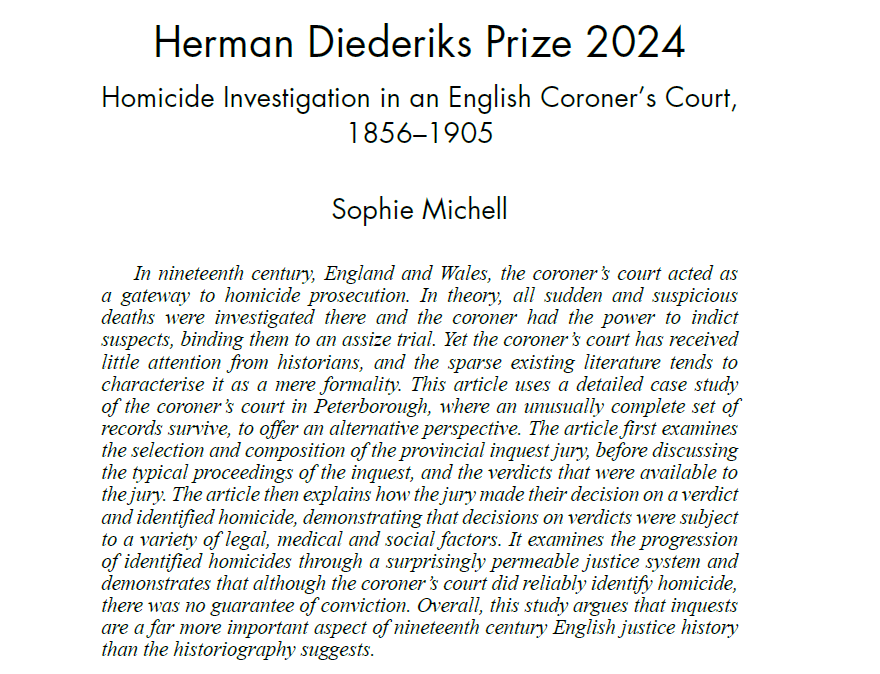
I’ve won two awards this year. The first was the Herman Diederiks prize for best article by a junior scholar in the field of European criminal justice history, awarded by the Fondation Maison des Sciences de l’Homme. My article is about homicide in the English coroner’s court and will be Open Access in two years!

The second was the Vice-Chancellor Lord Perry Award for research excellence in the social sciences, awarded by the AOUG. I had a lovely afternoon celebrating and reading the nice things my supervisors said about me.

What comes after the thesis? Well, watch this space.

If you would like to book me for work or to speak at your event, please get in touch!

Events: Autumn 2025

Hello everyone, long time no blog because I’m deep into writing my thesis up and it has to take priority. HOWEVER, I have a couple of local events coming up that I thought I would draw your attention to.

First, on 2nd September 2025, I’ll be speaking to Folksworth Ladies Circle at Folksworth Village Hall at 7:30pm about Victorian inquests in the area. Non-members are welcome, at a cost of £2.

And on 6th November 2025, I’ll be speaking to Werrington Local History Group at Werrington Village Centre at 7:30pm. This talk covers death on the railway, and will be similar to the talk I gave at the museum last year, but with more focus on Werrington. Non-members are welcome, and it will be £5 on the door.

I will be speaking at Werrington again in October 2026 about RIOTS! but that’s quite a long way off…

I hope you can come!

If you would like to book me to speak at your event, please get in touch!

Friday Murder Roundup 2024

I’ve been very quiet on here this year because I’ve been working exceptionally hard on my PhD and lawd, it takes up the time. I have a few public events booked in next year, and will share more information closer to the time.

However, I’ve been writing murders on my substack all year, but they don’t come up on Google searches. So, here is a linked list, an index. They’re all free to read, and if you’d like a little murder every other Friday in term time, subscribe!

I deliberately name the victim, not the killer. Some of these murders ended in execution, some in acquittal, some in laughably brief prison sentences (and I’ve indicated which in the list).

But my focus is, and always will be, on the people who died.

Ann Mason, Godmanchester, 1891. Murderer died on remand.

Joseph Leatherdale, Salcott, 1890. Death sentence commuted to life imprisonment.

Jeremiah Preston, Lyddington, 1878. Six weeks in prison for gross negligence.

Elizabeth White, alias Bess Knox, Berwick, 1871. No criminal charges.

Elizabeth Fallon, Bradford, 1909. Six months imprisonment for manslaughter.

An International Women’s Day special

Thomas French, Castor, 1816. No criminal charges.

Emily Ann Bignall and her unborn child, Shenley, 1888. Death sentence commuted on account of insanity.

Hannah Maria Whittley, Halifax, 1908. Executed.

Catherine Ellis, Ardwick, 1871. Death sentence commuted to life imprisonment.

Sarah Ann Insole, Grimsby, 1887. Executed.

Jane Smith, Antony Plow and Hilda Plow, Todmorden, 1868. Executed.

Jessie and Walter Black, Hove, 1893. Murderer died at scene.

The 23 Victims of the Clayton Tunnel Accident, Brighton, 1861. No criminal charges.

Margaret Ann Baxter, Ryton, 1856. Discharged by magistrates.

John Gill, Manningham, 1888. No criminal charges.

Emily Joy, Godalming, 1889. Executed.

Charles Spencer, Walkeringham, 1860. Executed.

Ann, James, Mary, Harriet and Thomas Saville, Nottingham, 1844. Executed.

The Victims of William Saville’s Execution, Nottingham, 1844. No criminal charges.

Mary Wild, Bilston, 1843. Eighteen months for attempted rape.

Lilian Alice Lyons Meek, Ipswich, 1883. Executed.

Charlotte Farmer, Gosport, 1883. Murderer predeceased victim.

Events!

I’m doing a couple of public events this summer!

First, an online talk for Curious Histories on 18th June. This will cover the Victorian coroner and inquest practice, using some Brighton-based case studies. This includes the infamous Brighton Poisoner case!

I’ve spent the last few months contributing to a railway exhibition at Peterborough Museum. On 19th August, midway through the exhibition, I’ll be doing an in-person talk at the museum about the nineteenth-century railway in Peterborough, through related inquests. I’m really looking forward to this, it’s very close to my heart.

BOOK HERE FOR THE BRIGHTON TALK

BOOK HERE FOR THE PETERBOROUGH TALK

I hope to see some of you there!

I’ll also be at the Social History Society conference in July, and I’m speaking at the British Crime Historians conference in September.

Year Five

Astonishingly, I’ve now kept this little business going for five years. It’s not always easy, with three kids and a PhD and numerous side projects humming along in the background… but I persist because it’s immensely rewarding. My books are currently open, but the waiting list is fairly long.

This year, I’ve completed six full length family trees, which covered 6675 people, and averaged out at 20k words each. I’ve also done four smaller commissions. I’ve taken part in two conferences, one seminar, given a public lecture at uni (which will be online eventually) and got involved in an exhibition at Peterborough museum on the history of the railway (coming in the summer)

I’ve joined the Crime and Punishment Collections network as their family history expert. I’ve written a whole bunch of murders (you can read them here) and found countless tiny stories (which are usually on twitter). I worked on one of the BBC’s top podcasts and started a women’s history group in my city with some wonderful friends.

And I started writing my thesis.

The next year doesn’t look any less busy… Thank you for your support, your custom, and your delightful enthusaism for my weird little history niche.

Get in touch with your own family research problems and questions using the contact page above.

Lady Killers

In late 2022 and 2023, I had the pleasure and good fortune to work on seasons 2 and 3 of the BBC podcast Lady Killers with Lucy Worsley, as a researcher for Professor Rosalind Crone.

The new series starts today at 11:30am on Radio 4, or you can listen to it on BBC Sounds. I worked on two cases, including today’s episode on Maria Manning. The Manning case was probably my favourite of all the six cases I’ve done across the two seasons, and you’ll ‘hear’ why if you tune in.

I also worked on the episodes in season two concerning Christiana Edmunds, Edith Thompson, Marguerite Fahmy (which had some wonderful primary sources) and the Liverpool poisoners, Flanagan and Higgins.

I’d like to thank Ros and StoryHunters for making the whole experience so much fun!

Every Friday Murder of 2023

I’ve been writing murders on my substack all year, but they don’t come up on Google searches. So, here is a linked list, an index. They’re all free to read.

I deliberately name the victim, not the killer. Some of these murders ended in execution, some in acquittal, some in laughably brief prison sentences (and I’ve indicated which in the list).

But my focus is, and always will be, on the people who died.

Laura Georgina Gray, Lewisham, 1901. No criminal charges.

Henry Barratt, Peterborough, 1864. No criminal charges.

Jane and Emma Baum, Syston, 1864. Found insane.

Alice Eliff, Deeping St James, 1884. No criminal charges.

Katherine Mabel Quatermass, Hemel Hempstead, 1896. Acquittal in magistrate’s court.

Mary Addington, Holcot, 1871. Executed.

Ann Cosford, Northampton, 1871. Fifteen months hard labour.

William Cox Newitt, Wood Burcote, 1873. Executed.

Elizabeth Robinson, Leeds, 1853. One year in prison.

George Cornish, Wells, 1868. Death sentence respited on grounds of insanity.

Olive Beasley, Dudley, 1872. Acquitted at assizes.

Harriet Baker, Burslem, 1877. Life imprisonment.

Eliza Frances Newton, Tunstall, 1878. Twenty years in prison.

Jane Mountfield, Crewe, 1875. Life imprisonment.

William Cooch, Kingsthorpe, 1877. Six months in prison with hard labour.

Maria Steggles, Bacton, 1853. Executed.

David Thompson Myers, Stamford, 1812. Executed.

Martha and Elizabeth Garlick, Astcote, 1875 and 1879. Acquitted at the assizes on the first count, six months hard labour for the second.

Harriet Elizabeth Hibbs, Glatton, 1879. Acquitted at the assizes.

An Abortion Special, England, 1855-1902.

Charlotte Hilton, Parson Drove, 1861. Executed.

Elizabeth Brookes, Aston, 1861. Life imprisonment.

Ann Walker, Birmingham, 1861. Executed.

Betsy and Emily Beamish, Coventry, 1861. Executed.

Stephen Coleman, Devizes, 1881. Executed.

Anastasia Trowbridge, Tollard Royal, 1860. Executed.

Hannah Cox, Steeple Ashton, 1859. One week in prison.

Ellen Wall, Birkenhead, 1876. Life imprisonment.

Rebecca Bannister, Hyde, 1876. Executed.

Emily Pimm, Birmingham, 1898. Six years in prison.

Ada Shephard, Acton, 1880. Executed.

Elizabeth Parker, Kettering, 1854. No true bill at assizes.

Ruth Sampson, Sheffield, 1881. Found insane.

Catherine Quinn, Manchester, 1887. Executed.

Felicitous McLavey, Wakefield, 1870. Acquitted at assizes.

Benjamin Black, Barton Bendish, 1867. Executed.

Broken Homes

This is a story of many broken homes. It is the story of a frightened, miserable pair of children. It’s not a homicide, so it doesn’t belong in the Friday Murder Club, but it is still heartbreaking. This is the story of Leah Eliza Bothamley.

But Leah’s story is not the start of the tale, because as anyone who knows about intergenerational trauma is aware, these stories are deeply rooted. Leah’s story begins in Newark, a tiny village on the outskirts of Peterborough. Edmund Whittington was born there in 1845, the illegitimate child of Leah Whittington and Frederick Bothamley. Leah and Frederick lived together from about 1840, but Frederick had a wife living eleswhere. It’s not clear how this marriage ended, but Frederick retained custody of his legitimate children. So, Edmund lived with his large blended family: four sisters from his father’s marriage, plus another seven siblings. It’s not clear what kind of childhood Edmund had – he was sufficiently literate to run a business, so much have had some formal schooling – but this was a lot of people to feed on a shepherd’s wages.* Edmund, who was always known as Edmund Whittington Bothamley, left Peterborough at his earliest convenience and headed for Dudley.

Frances Favell Garn had a similar childhood. Her mother, Ann Thompson, was born shortly before her parents’ marriage in 1797 at Farcet. Ann then married a man named Henry Garn, another shepherd, and spent some time living in Yaxley. However, between 1825 and 1829 (the timeline is shaky), she left Henry to live with Robert Sisman Favell. Robert was born in Buckworth near Alconbury and swept Ann away to er… Spalding Common. Robert ran the Green Man pub there, and also practiced butchery on the side. Henry Garn must have died in the 1840s, because Robert and Ann married in Alconbury in 1847.

Frances was well aware of her illegitimacy, although it’s unclear whether she minded. She grew up in a large household, with ten siblings. Again, we cannot tell if the house was a happy one.

Edmund married Caroline Pearson in Old Swinford in 1869, and they lived in Dudley where Edmund was a butcher. Seven children followed. One died at birth, and four of the others lived barely to their first birthday. Two survived: Henry Edmund was born on 16th December 1872, and Leah Eliza was born on 6th December 1873. Irish twins.

Caroline died shortly after the birth of her last child, in March 1878. Edmund returned to Peterborough where his father was still living, and he had numerous siblings who could help out.

Meanwhile, Frances was having a dreadful time. She married Thomas Beech in June 1857, when she was around twenty. They lived in various places, including Southwark and Derby, as Thomas worked as a valet. However, when Frances’ father died in 1865, Thomas took over the Green Man pub. They had two daughters together, but one died young. The survivor, Thirza, was born in 1868.

Thomas was an incredibly abusive man. The abuse started within a few months of the marriage. He beat Frances constantly, and his behaviour escalated as time went on. He knocked her teeth out. He threatened her with a large knife. He told her he’d like to rip her up like a sheep. In July 1878, he knocked her out cold by punching her in the back of the head, and a few months later beat her until she was black and blue. He committed adultery throughout the marriage, but had a long term relationship with Sarah Stennett, commencing in mid-1871. Thomas was thirty-five at this point, and Sarah was fourteen. In August 1878, Thomas and Sarah ran away to Horncastle to live together: he beat Frances when he briefly returned.

At this point, Frances had had enough. She filed for divorce on Christmas Eve 1878, a procedure that was eye-wateringly expensive. It’s not obvious how she could afford it, but it’s possible one of her many brothers helped out. The petition got as far as the nisi stage, granted in March 1878, but the divorce was never completed. In 1881, Thomas was living with Sarah Stennett in Spalding, and was listed as married. Sarah was listed as his housekeeper. She gave birth to two of his children but married elsewhere in 1883, and coincidentally, moved to Peterborough. Thomas died in Spalding in 1892.

Although Frances was not free to marry, it appears she believed she was. It’s not clear how she met Edmund but one of Edmund’s sisters worked in Farcet where Frances had aunts, so it’s possible they met that way. They married on 2nd November 1879. Edmund was working as a butcher in Gladstone Street, and Frances lived in Cobden Street.

By 1881, the new family – Edmund and Frances, thirteen-year-old Thirza, eight-year-old Henry and seven-year-old Leah – were living on Cobden Street, a large house close to Cromwell Road. Edmund was a butcher, and also sold milk. The children were expected to help out in the business, taking orders round to people and collecting money.

Both Henry and Leah ran riot, according to Edmund and Frances. Henry was a particular bother. Every school in the city had blacklisted him, and one one occasion he’d run away as far as Boston. Edmund had approached the magistrates and other local solicitors for help with the boy, the the magistrates declined to help, saying it was a family matter, not a criminal one.

Edmund and Frances disciplined the children in the only way they knew how – they beat them. And the more they were beaten, the more the children ran away. They did not want to ‘catch it’. Such was the pattern of behaviour established. Leah was fearfully unhappy, and on one occasion, told a friend that she’d cut her throat before she went back home. She was seven.

In the first week of December 1881, Leah stole sixpence and Frances beat her with a cane. According to rumour, Leah was seen with blood running down her face. A few days later, on Saturday 3rd, Leah was in trouble again: she took some meat to a neighbour, lied about the cost and pocketed the change. She was quickly found out – the neighbour complained about the cost of the meat. Frances swore that she had not beaten the child again only ‘chastised’ her. Leah cheered up, and met her father in town. He asked her to take some butter home. She did, and asked her stepmother to make a cake for her birthday with it. Leah left the house after lunch and was not seen alive by her parents again.

She was, however, seen. A young boy playing down by Mr Little’s Pond on Cromwell Road, behind St Mark’s church, saw her standing knee-deep in the water, in her shows. This was no minor duck pond, it was a large body of water. He asked her what she was doing and she told him that she was going to run away. The boy left her there, in the dark.

Her body was not recovered until the 14th December, and only then by accident. A basket maker had soaked some willow branches above the spot she died, and found her body when he pulled them out. It was cold, and her body was well preserved. She had a bruise on her forehead, and her hands were clenched, but all evidence suggested that she’d gone into the water under her own steam.

But why?

Leah’s disappearance caused an outcry around Gladstone Street. Everyone knew her, everyone knew she was a tearaway, and everyone blamed her parents. The rumours said that Frances had killed her, that her parents were tyrants. And so the inquest was as much about exonerating them from blame as establishing how Leah came to drown in a pond.

Frances and Edmund were puzzled by the behaviour of his children. Thirza – who we may recall was raised in the house of a thug – was a quiet and obedient girl. Leah and Henry, who lost their mother aged five and four and were then dragged away from the only home they knew to Peterborough, were not. Frances and Edmund kept a ‘comfortable’ house: the children were well clothed and fed. But were they loved?

Frances told the inquest she believed the children were naturally bad.

Henry, who was about to turn nine, gave evidence at the inquest too. He told them that sometimes, he got distracted running errands and then ran away rather than go home late and be beaten. Henry told them that his father only hit him when he was a naughty boy.

Leah was too young to legally commit suicide, which was still a crime in 1881 as it would remain for another eighty years. But it seemed unlikely to be an accident, so her death was ruled “found drowned”. She was three days shy of eight years old.

The Bothamleys left Peterborough soon after this, perhaps because of shame or maybe grief. They made their way to Birkenhead so Edmund could work on the ships as a cook. He died at sea from malaria in July 1884. Thirza died a month later.

Frances remarried in October 1885, but died herself in 1892. Henry married, and emigrated to Canada. He died in Nanaimo in 1962, aged eighty-nine, the only person in this story who saw old age.

***

It does not do to psychoanalyse the children of the past. There is too much difference in social expectation, in living conditions, in understanding, and indeed the very concept of childhood. But I am the neurodivergent parent of three neurodivergent childen, and I recognise some of Henry and Leah’s behaviour. You might too.

We could speculate that Frances was numb to the needs of the children from her own two decades of terror, that she didn’t want to upset the applecart because she’d found a safe haven with Edmund (although we have no evidence he was a decent husband). We could speculate that Edmund was tired of his children, tired of the lack of support, tired of trying and failing to discipline these kids he didn’t understand. We could speculate that the highest priorities of these two adults was meeting the basic needs of the children, but they lived in a kind of emotional austerity, where parental love was transactional, not a right.

Leah died, whether by accident or by design, because she was a terrified little girl who feared the bollocking she was going to get when she went home. She died in the dark, on a freezing night, three days before her birthday.

Did anyone love these children, this boy and girl who (as the coroner said) were “naturally inclined to do wrong”? It seems not.

*Frederick Bothamley also worked as a butcher, but his primary occupation was given as shepherd on the census and his children’s baptisms.

Get in touch with your own family research problems and questions using the contact page above.

What’s in a Name?

I was recently fortunate enough to do a public lecture for the Open University as part of their series of postgrad lectures. In the Q&A session, I was asked why I choose to name the people I write/speak about, and the ethics of doing so.

My work, whether academic or commissioned, takes me into the darkest murk of the past. This is not the history of success, evolution and great men. This is the history of the masses; the history of the poor and the illiterate and the distressed. These histories come to us through the unsympathetic lens of the legal system, whether it be an inquest, police court or assizes. But this paperwork is the end product of an investigation, and it pulls the threads of many lives and events into a few sheets of paper. This process of distillation is most apparent in the criminal trial records.

A name, a crime, a verdict, a sentence.

I am a compulsive storyteller. I want to tell everyone about the frankly insane things I trip over in the records. I cannot let them go. But a thesis is not a story, nor is it a book. A thesis is an argument. The only stories that are allowed in are those that evidence that argument. There are hundreds of stories I will not be able to tell in my thesis.

I cannot put them aside. They linger in my brain. Telling these stories online, whether through twitter, or on this website, or in my substack, is an act of exorcism. However, I am uninterested in voyeurism. I do not wish to point at the subjects of these stories and laugh, or pore over the wreckage of their bodies, or tut at their misfortune. I have no desire to be salacious, to sex up the nineteenth century (it does not NEED sexing up, believe me). I want to tell a truth these people would recognise, if they could somehow skip through time and read it.

So, naming the dead. We do not ask biographers about how they decide whether or not to name their subject. We assume that biography is a good thing, a celebration, a reflection of glory. But writing about death or crime is furtive, a thing that may shock, an inheritance of shame.

Nothing I write about is a secret, nothing I write about is difficult to source. It is all a matter of public record, and I don’t mean hidden and uncatalogued in an obscure archive. These stories are in the newspapers. They are digitised, searchable in a way the subjects could never have imagined, in their world of ribboned files, inkpens, wax seals, carbon paper and parchment. The ease of access blurs the ethical lines: if I can find this so easily, so can anyone, so it doesn’t matter.

But it does matter. My academic work is extremely localised, and there are descendants of my subjects around here. This has become increasingly apparent when doing family histories for friends and neighbours, and finding their distant ancestors living in the parish next door. So when I did a talk on a murderer, who killed in 1880, but did not die until 1942, and had six children while living in the city, I was very conscious that I might be talking to their great-grandchildren.

But I still named them, as I name almost everyone I write or talk about.

It humanises them.

Academic history requires an amount of mental gymnastics. One writes as if the history fell upon the page by accident. I cannot be angry in my thesis, I cannot rail against injustice, I cannot mourn. I have to dismantle their lives to make my point. I have to use their deaths to make my point. I have to be measured… I have to be distant.

But I am not distant.

I am enmeshed in imagining the lives of my subjects; I cannot do justice to their stories if I remain unmoved and impartial. I have wept in the archive at a mother’s testimony of finding her dead child. I have flinched at descriptions of dreadful injuries sustained and briefly survived. I have dwelled on the state of mind of the deceased far longer than any coroner’s jury seems to have done.

There are 1080 inquests in my data. It doesn’t matter whether they died in their sleep, or were murdered; they all matter to me. I want to retain their dignity. In telling you about their deaths, I hope I can give you an insight into their lives and their experiences.

And that starts with a name.

***

I write about death every week, and you can subscribe to my substack by clicking on this link.

Get in touch with your own family research problems and questions using the contact page above.