The Frenchman and the Wealthy Widow

The chief benefit of using the family reconstitution method when researching family histories is that you get a much wider angled lens on a family group than you would if you focused in on the individuals. This is a story that has been told in fragments across many different sources (not least, by me on twitter) but only makes proper sense as an intergenerational story.

This is a story that starts with a rich man, Henry Moses, a Jewish wholesaler in Tower Hill, who set up a trading link with Australia in the 1830s and made a fortune. Among his many children was a daughter, Rachel Adelaide, born in approximately 1834.

Like all Henry’s children, Rachel made a good marriage. She married John Davis, a wealthy Jewish trader, in London in 1856. A year later, when Rachel was either heavily pregnant or recently postnatal, John died. He left her a small fortune, and she took her baby boy, John Mortimer Davis, to Brighton to recover from her bereavement.

There, she met a French sculptor named Louis Nicolas Adolphe Mégret. Louis converted to Judaism to marry Rachel in 1862, and then kept her solidly pregnant for the next seven years. In 1867, he persuaded her to move to France. While suffering postnatal depression in 1870, she consented to go and stay in an asylum in Paris.

And Louis left her there. He did not visit. He did not write. He did not respond to the letters she sent. Instead, he took all the children, including John Mortimer to England, where he set about redirecting the Davis trust fund into his own coffers. The trustees believed his story about Rachel being insane – why wouldn’t they? – and Louis had custody of John Mortimer, who had a great deal of money settled on him in his own right. John’s uncle Alfred had died childless in January 1870, settling another vast sum on the adolescent boy. This may have been the reason Louis engineered Rachel’s confinement.

Rachel was fully recovered from her illness by the end of 1871, but Louis continued to ignore her. He recanted his Jewish faith and returned to Roman Catholicism, had their children baptised and put all his efforts into getting John Mortimer to convert. He employed a woman to look after the children, who subsequently married John Mortimer, despite being twenty-two years his senior and John being a teenager and unable to marry without parental consent.* Louis sold Rachel’s jewels, furniture and clothing..

Finally, in 1876, Rachel convinced the asylum directors that she was sane, and was released. She promptly applied for a separation from her husband, but the French court said no and ordered her to go back to living with Louis. Louis kept her a prisoner in their home for the next few months, locking her in when he left the house. Then he had her incarcerated in Charenton Asylum near Paris.

This time, Rachel managed to get word to her English solicitors who arranged her release, and she subsequently escaped to England. John Mortimer, then on the cusp of turning twenty and still an ‘infant’ in English law, brought a court case against his stepfather to reinstate his mother’s inheritance.

The court found in Rachel’s favour. Her money was reinstated and Louis was ordered to pay back the funds he had misappropriated. Rachel did not seek a divorce, presumably because Louis would take all her assets.

And that is mostly the end of Rachel’s story. She does not appear on the 1881 or 1891 census, and may have been living in France. She died in Ticehurst House Asylum after a two month admission, in 1899. Louis was still alive when she died, but his death is untraceable. Their seven children lived in both London and Paris.

John Mortimer Davis’ story does not end here though. Rachel had an older brother – Samuel Henry Beddington.** Samuel had married Zillah Simon and they had four beautiful, Bohemian daughters who became quite famous in their social circle, being friends of Oscar Wilde and Proust, and one was the lover of Puccini. Their second daughter, Evelyn Kate Beddington, eloped with John Mortimer in 1888. Her parents opposed the match, possibly because they were cousins, possibly because of the scandal associated with John’ s mother, possibly because they knew he had been married before. John was a wealthy man, and a barrister, so it’s unlikely they opposed the marriage on practical grounds.

The marriage was miserable. They lived in Hyde Park, without children, while Evelyn was incessantly unfaithful. John tired of being cheated on, and filed for divorce in April 1892 against Evelyn and her lover, Sidney Starr.

The divorce was never completed. John shot himself in Edinburgh on 1st October 1892. The inquest was broadly kept out of the newspapers, and blamed their marital issues. It probably also quietly alluded to his mother’s time in asylums.

John was thirty five. had been deprived of a father around the time he was born. His mother was forcibly absent from his life throughout his adolescence, while his stepfather did his best to mould him into a pliant Roman Catholic. He was (probably) seduced into an ill-advised marriage with a much older woman, which was then either dissolved or hidden under the carpet. The court case he was forced to open to reinstate his inheritance was reported salaciously across the country. His in-laws, his own aunt and uncle, didn’t want him to marry their daughter. His wife was repeatedly unfaithful, and divorce was stigmatised. He had no children and little contact with his younger siblings. The only thing he did have was money, and lots of it. His estate on his death was worth £93,510, somewhere between forty and seventy million pounds today. He left the bulk of the money to a woman named Nellie Kauffmann, who he perhaps planned to marry, and to his siblings, Henry, Anita, Blanche and Constance Mégret .

Evelyn remarried in 1894. Her second husband was Walter Eugene Behrens, and they spent their married life in France. Evelyn died in 1910, aged 46. One of her biographers hinted that she may have died of syphilis. Walter Behrens died in 1922. They had twin sons.

Get in touch with your own family research problems and questions using the contact page above.

* This marriage was either dissolved or ignored when it came to John’s second wife.

** This branch of the Moses family changed their surname to Beddington in approximately 1866.
Event!

I am doing a talk at Peterborough’s John Clare theatre on 26th June, at 2:30pm.

The talk is called Baby Murderer? and is about using coroner’s records to flesh out criminal cases from the past. I plan to discuss the research methods I used in my Masters thesis, the use and rarity of coroner’s archives, and how the amateur family historian can use the same techniques.

You can find out more here.

The Census: Uses and Limitations

The census is an invaluable resource, provided you can read it, and forms the backbone of any family research. This is a brief overview of each census taken in England and Wales, between 1841 and 1911, and its uses and comparitive limitations.

1841: taken 6th June

Includes: Street names, householder names, genders, ages (see limitations), occupations, whether born in England.

Limitations: Ages over 18 are rounded up to the nearest five, which can throw your age calculations right out. Street names are only given for large settlements. Generally difficult to read. No relationships between householders. No disability information. No place of birth information, although whether they were born in the county they lived in is included. Foreign births restricted to Scotland, Ireland or ‘Foreign Parts’.

1851 – taken 30th March, and 1861 – taken 7th April.

Includes: Street names, householder names, gender, marital status, relationship to Head of Household, ages, occupations, town of birth, limited disability classification.

Limitations: Street names are only given for large settlements. Pub names not always included on the 1851. Disabilities limited to ‘Blind’ or ‘Deaf/Dumb’.

1871 – taken 2nd April, and 1881 – taken 3rd April

Includes: Street names, householder names, gender, marital status, relationship to Head of Household, ages, occupations, town of birth, disability classification.

Limitations: Disabilities limited to ‘Blind’, ‘Deaf/Dumb’, ‘Imbecile or Idiot’ and ‘Lunatic’!

1891 – taken 5th April

Includes: Street names, householder names, gender, marital status, relationship to Head of Household, ages, occupations, town of birth, limited disability classification, employment status (employer, employed, neither), number of rooms occupied if less than five.

Limitations: Disabilities limited to ‘Blind’, ‘Deaf/Dumb’, and ‘Lunatic, Imbecile or Idiot’. No clarification of employment status if neither employed or employer, no indication of how many rooms occupied five or more.

1901 – taken 31st March

Includes: Street names, householder names, genders, relationship to Head of Household, marital status, ages, occupations, town of birth, limited disability classification, number of rooms occupied if less than five, employment status (either Employer/Worker/Own Account or Working From Home).

Limitations: Disabilities limited to ‘Deaf/Dumb’, ‘Blind’, ‘Lunatic’ or ‘Imbecile, Feeble Minded’. No indication of how many rooms occupied if five or more.

1911 – taken 2nd April

Includes: Street names, householder names, genders, relationship to Head of Household, marital status, ages. Employment status, occupation and within which industry. Town of birth, nationality. Limited disability classification and age when afflicted. Length of marriage, number of children born within that marriage, number of childen living/dead. Number of rooms occupied.

Limitations: Difficult to see surrounding neighbours without checking more census returns. Sometimes difficult to work out number of children born to parents who have remarried, or married after having children. Disabilities classified as ‘Deaf/Dumb’, ‘Blind’, ‘Lunatic’, or ‘Imbecile/Feeble Minded’.

And looking forward to the 1921 – taken 19th June

(to be released January 2022, I can’t wait)

Includes: Addresses, householder names, genders, relationship to Head of Household, marital status (including divorce for the first time), ages in years and months. Whether a child is orphaned or partly-orphaned. Employment status, occupation, within which industry and employer name. Place of education for children. Town of birth, and nationality. Number and ages of all living childen and stepchildren under 16.

Limitations: No disability information. No information on dead children. No information on housing type. This census was taken during holiday season, meaning that families may not be where you expect them to be!

There is also the 1939 war census. This was taken on 29th September 1939, for the purpose of issuing ration books. It holds name, sex, marital status, address, date of birth and occupation for every household member. I tend to find the 1939 is pretty poorly transcribed, and the addresses are vague, but it’s an invaluable stopgap between the 1911 and the present day.

Get in touch with me about your own family research questions on the Contact page above.

So, Your Grandmother Was A Prostitute

It’s an ongoing joke among those who know my work that if there’s a prostitute in the family, I will find them. Sex work is the world’s oldest profession, so it’s no surprise to discover someone in the hundreds of members of any given family tree made a bit of money that way, but how does the family historian identify them?

First, you need to know something of sexual culture in the Victorian era. There was a long-held idea (of both contemporary men and some historians) that an unmarried woman who became pregnant MUST have been a prostitute, which is patently rubbish. Women in cohabiting relationships were also considered prostitutes. The evidence shows that many working-class couples did not marry until their first child was expected, suggesting that sex was an accepted part of courtship patterns once a couple were engaged. Engagements could last for years, while a man found steady work, so perhaps sometimes a baby sped things up a bit. Other historians think it was a way to check fertility before committing to marriage. There was very little privacy in any Victorian neighbourhood. People lived, as Emily Cockayne put it in her book on neighbours, cheek by jowl. In towns, you might have ten or eleven families living in one courtyard, making it an unlikely place for a young couple to get much privacy. In villages, even open fields were likely to be in view of someone. And then there was the matter of TIME: young people were in full-time work before they hit sexual maturity. Men worked twelve hour days minimum, and women were either working all day in domestic service placements, all day in a textile mill, or all day at a home-based job. In short, opportunities for sexual behaviour before marriage were limited, and tended not to be wasted.

You also have to consider your personal definition of prostitution. I have found a great many rape cases reported where the man was acquitted because he paid his victim afterwards, which tells you a lot about Victorian courts. I have read bastardy court reports where putative fathers got other men who had slept with the mother of an illegitimate baby to give evidence, and relieve them of paying maintenance. A woman who had slept with more than one man did not fit the Victorian idea of an innocent led astray into pregnancy, and would have been considered a prostitute according to the morals of the time. And can you really blame a woman in dire poverty for selling sex rather than starve?

Prostitution was tolerated, and indeed licensed until 1885. It is rare to find a woman prosecuted for prostitution in Victorian newspaper columns, although sex workers arrested for other offences (being drunk or theft, most commonly) were usually identified as ‘notorious’, ‘wanton’ or ‘loose’. Some prostitutes were widows, stuck with a family to feed and no childcare to work around. Others were women who may have been coerced into sex work, or simply decided it was better to sell sex than get married or stay in an abusive relationship. In towns, women were more likely to work the streets than from home.

Things began to change as women began to be idealised in Victorian culture as a calm and angelic mother figure, deifiying the domestic sphere. The Contagious Diseases Act (1864-1869) was introduced to forcibly send prostitutes for treatment of venereal disease for two months, effectively imprisoning them without arresting them. The age of consent was raised from twelve to sixteen in 1885, which helped stop the trade in child prostitutes. Evangelical movements developed to ‘save’ women. If you find a female relative living in a non-workhouse institution in the late Victorian period, make sure you google the institutions: a great many charitable homes for child prostitutes and street workers opened in this era, some for only a short amount of time.

There is an old trope that ‘laundresses’ and ‘seamstresses’ on the census were just euphemisms for sex workers. This is not the case: a great deal of widowed and unmarried women made their money doing laundry and mending clothes. It is difficult to imagine the sheer amount of TIME it took to get your washing done when you had to boil the water by the bucket, scrub all the washing by hand, rinse it by hand, mangle it and then try and get it dry. It took all damn day, and women who could afford to pay someone else to do it for them did, even if they couldn’t afford a servant. As for sewing, when ALL your clothes were made by hand, and expensive, you couldn’t throw a shirt or dress away when it tore. Seamstresses were always in demand. However, a fair amount of laundresses and seamstresss may have sold sex on the side.

So, how do you know if your great great great grandmother was a prostitute? The truth is, unless you can find them living in a home for ‘fallen women’, or arrested for a sex-work offence, you can’t know for sure. Unmarried pregnancy alone is not enough evidence, since many women gave birth before marrying or were pregnant on their wedding day.

However, a woman who had several children outside marriage warrants extra investigation, as does a young woman living completely independently without any apparent job. The Poor Law would not give relief to an able-bodied woman without children; she was expected to work for a living.

Get in touch with me about your own family research questions on the Contact page above.

Pedigree Collapse

Everyone is related to everyone, if you go back far enough. The thing that people miss is that this also means everyone is inbred. Everyone. Somewhere, probably not too deeply in the mists of time, one of your family branches split, only to reunite several generations later.

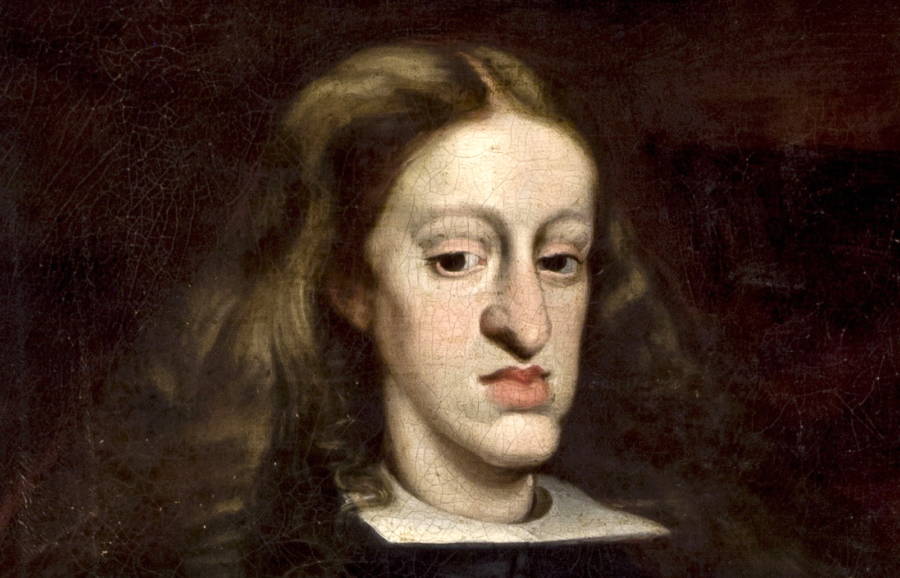
Now, there were strict laws in place until the early twentieth century to prevent people marrying (and thus reproducing) with family that were too close in blood. You were allowed to marry a first cousin, and people did IN DROVES, but anything closer than that was forbidden. Unless you were Spanish royalty, in which case you might have ended up like Charles II of Spain:

Yikes. Poor Charles was a Habsburg, a family so resolutely devoted to marrying other Habsburgs that their fertility diminished to nothing – Charles was the only child to see adulthood of his father’s fourteen liveborn children. Charles’ parents were uncle and niece (ew), his paternal grandparents were cousins (and one set of his great-grandparents were also uncle and niece), and his maternal grandparents were also cousins. This was not a gene pool likely to produce healthy children. Charles probably had acromegaly, and various other genetic disorders, and died without issue. This plunged the Spanish into a succession crisis, but was…perhaps for the best?

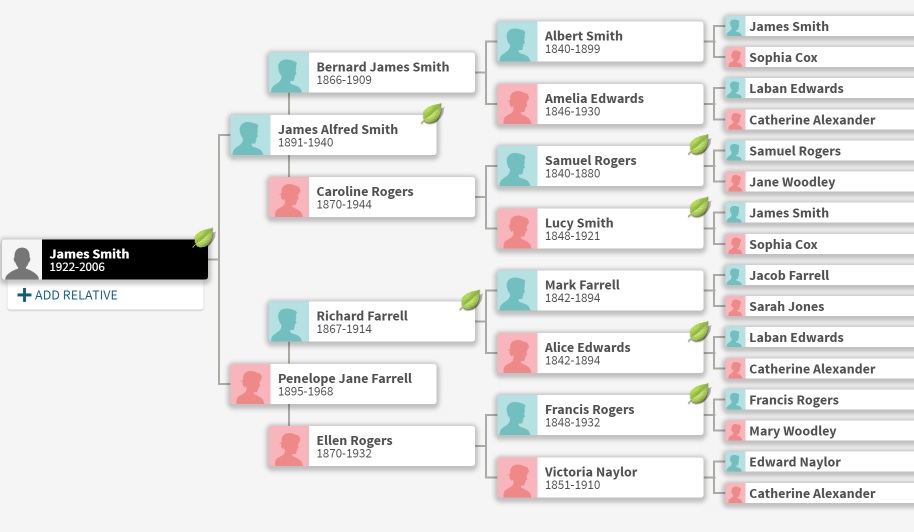
The common people were protected from this sort of thing by consanguinity laws. Some of these laws seem a bit daft now – you weren’t allowed to marry your dead husband’s brother until 1931, although people did. However, pedigree collapse, when your family pedigree stops dividing because everyone’s related, still occurs from time to time. Here’s an example which is based on a real family tree I did:

This is completely fictional, despite Ancestry thinking these are real people. Anyway, James Smith has two parents, four grandparents and eight great-grandparents. It’s the fifth generation where the problem creeps in – he only has eleven great-great grandparents instead of the expected sixteen. If you go a further generation back, and assume Jane and Mary Woodley are sisters, and Samuel and Francis Rogers are brothers, then he has just eighteen greatx3 grandparents instead of thirty two.

None of James Smith’s family is ostensibly inbred. Nobody’s marrying siblings, or nieces or nephews. The closest familial intermarriage is between cousins, and both lawful and standard in the nineteenth century. But the cumulative effect is to decrease the gene pool across time. If James Smith had also married a cousin, perhaps a child of Penelope’s sister, the pedigree would have continued to collapse, but there may have been no obvious effect on their descendants.

This is pedigree collapse as you are most likely to find it, and you’ll most often find it in small villages without much economic migration. You may notice a decreasing fertility across time in families like this, although you should also bear in mind that fertility did drop across the nineteenth century due to increased use of contraception. You may also notice an increased number of infant deaths.

Get in touch with me about your own family research questions on the Contact page above.

Welcome!

Please check out my website for services, events, basic pricing and contact details.

I post occasional blogs on topics related to family research. If there’s any subject you would like me to cover, let me know!

Gift Vouchers

If my waiting list means you won’t receive your family history before the necessary date, I am able to offer gift vouchers.

Printed in colour, on A5 170gsm paper, the voucher features your chosen individual’s family search result on the back, as well as my website details so they can find out more about what their gift is.

Front of voucher
Back of voucher, featuring search results

Postage is free, and includes a gift envelope.

Presentation Options

I offer two types of presentation for the full sized family histories.

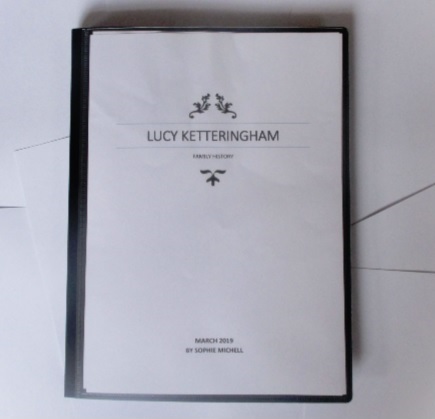
The option (included as standard) is binding in a presentation folder:

A typical finished book in a presentation folder

However, for longer books, presentation folders don’t work: they’re too heavy and unwieldy. For books over eighty pages, I offer wire-binding. This costs £5 extra, but looks great:

If you would prefer your book to be wire-bound, regardless of size, please let me know on ordering.