I was recently fortunate enough to do a public lecture for the Open University as part of their series of postgrad lectures. In the Q&A session, I was asked why I choose to name the people I write/speak about, and the ethics of doing so.
My work, whether academic or commissioned, takes me into the darkest murk of the past. This is not the history of success, evolution and great men. This is the history of the masses; the history of the poor and the illiterate and the distressed. These histories come to us through the unsympathetic lens of the legal system, whether it be an inquest, police court or assizes. But this paperwork is the end product of an investigation, and it pulls the threads of many lives and events into a few sheets of paper. This process of distillation is most apparent in the criminal trial records.
A name, a crime, a verdict, a sentence.
I am a compulsive storyteller. I want to tell everyone about the frankly insane things I trip over in the records. I cannot let them go. But a thesis is not a story, nor is it a book. A thesis is an argument. The only stories that are allowed in are those that evidence that argument. There are hundreds of stories I will not be able to tell in my thesis.
I cannot put them aside. They linger in my brain. Telling these stories online, whether through twitter, or on this website, or in my substack, is an act of exorcism. However, I am uninterested in voyeurism. I do not wish to point at the subjects of these stories and laugh, or pore over the wreckage of their bodies, or tut at their misfortune. I have no desire to be salacious, to sex up the nineteenth century (it does not NEED sexing up, believe me). I want to tell a truth these people would recognise, if they could somehow skip through time and read it.
So, naming the dead. We do not ask biographers about how they decide whether or not to name their subject. We assume that biography is a good thing, a celebration, a reflection of glory. But writing about death or crime is furtive, a thing that may shock, an inheritance of shame.
Nothing I write about is a secret, nothing I write about is difficult to source. It is all a matter of public record, and I don’t mean hidden and uncatalogued in an obscure archive. These stories are in the newspapers. They are digitised, searchable in a way the subjects could never have imagined, in their world of ribboned files, inkpens, wax seals, carbon paper and parchment. The ease of access blurs the ethical lines: if I can find this so easily, so can anyone, so it doesn’t matter.
But it does matter. My academic work is extremely localised, and there are descendants of my subjects around here. This has become increasingly apparent when doing family histories for friends and neighbours, and finding their distant ancestors living in the parish next door. So when I did a talk on a murderer, who killed in 1880, but did not die until 1942, and had six children while living in the city, I was very conscious that I might be talking to their great-grandchildren.
But I still named them, as I name almost everyone I write or talk about.
It humanises them.
Academic history requires an amount of mental gymnastics. One writes as if the history fell upon the page by accident. I cannot be angry in my thesis, I cannot rail against injustice, I cannot mourn. I have to dismantle their lives to make my point. I have to use their deaths to make my point. I have to be measured… I have to be distant.
But I am not distant.
I am enmeshed in imagining the lives of my subjects; I cannot do justice to their stories if I remain unmoved and impartial. I have wept in the archive at a mother’s testimony of finding her dead child. I have flinched at descriptions of dreadful injuries sustained and briefly survived. I have dwelled on the state of mind of the deceased far longer than any coroner’s jury seems to have done.
There are 1080 inquests in my data. It doesn’t matter whether they died in their sleep, or were murdered; they all matter to me. I want to retain their dignity. In telling you about their deaths, I hope I can give you an insight into their lives and their experiences.
Burnham Market in Norfolk is a most unlikely place for a scandal, and yet here we are.
In the summer of 1852, a young man named Reverend Frederic William Waldron took a job at Burnham Market. He was fresh from a spell of as a naval chaplain and looking for something more permanent. Reverend William Bates, a few years older than Waldron, needed a curate. So, Waldron went to Burnham and worked under a two-year contract.
In January 1854, he went away to Tunbridge Wells for his health, and in the interim found a more attractive job: schoolmaster in a private school in Leicestershire. He gave three month’s notice on his return. But he did not actually leave Burnham until November 3rd 1854.
In early 1855, Reverend Bates learned something disturbing, and wrote to the school, rescinding his reference. He also wrote to Waldron:
“Sir. The whole of your wickedness is now revealed, and I am sure your heart, mind, principles and conduct are in themselves very bad, and you will never have the grace to repent. I advise you at once to abscond and to hide yourself where you will never be heard of more. If you don’t return all the testimonials, i shall advertise you in the Ecclesiastical Gazette.”
Ouch.
Now, normally, this kind of scandal would go unreported. We would have no idea what had happened, even if Bates had gone so far as to advertise Waldron in the Ecclesiastical Gazette, because it seems Bates did not want to fully spell out what had happened. But Waldron decided to sue Bates for libel…and so the entire miserable story came out in the courts, was picked up by the newspapers, and reported in the Norfolk Chronicle.
In Burnham, both of the clergymen were unmarried. They lived in separate establishments. Bates, having a larger house, had two servants. Bates tried to find a suitable, older woman to act as housekeeper to Waldron, but he wanted a “pretty girl”. So a compromise was made. Mrs Childs, the local schoolmistress, joined Waldron’s house. And in the summer of 1853, a local girl called Louisa Johnson went to work for him. Louisa was fifteen. She was born in Burnham in October 1837, and her family lived on Front Street. Despite her family being very close by, she lived-in with Waldron. She had left school at twelve, worked for a dressmaker for two years and then worked in the National School as a monitor.
Louisa got the job with Waldron via Mrs Childs, her boss at the school. Her parents presumably believed she’d be safe, with Mrs Childs acting as chaperone. They were wrong.
Within a month of Louisa commencing work, Waldron was all over her, trying to kiss her, trying to get her to sit on his knee. He only did this when Mrs Childs was out. He asked her how high she tied her garters, and tried to touch her legs. He put his hand under her clothes, and tried to get her on her own. He asked her to have sex with him.
He told her God never made man to live alone, and he had no means to marry, and he did not think it wrong for her to have sex with him.
In January 1854, around the same time that Waldron became concerned for his health, he escalated his assault on Louisa’s virtue. He knocked at her (locked) door at night, begging her to let him. And once he had his new job lined up, he seems to have stopped caring whether he had permission or not. On 9th April 1854, he picked the lock on her door and “succeeded in effecting my ruin“. He wrestled her, pinning her down. She said she told him she would tell, but “he said it was of no use, nobody would believe me, they would take his word before they would take mine.”
Louisa complained to Mrs Childs about this behaviour, but Mrs Childs chose not to get involved. She held her position at the school by virtue of Reverend Bates, and does not appear to have wanted to wreck her employment because of a housemaid. She told Louisa to complain to Mr Bates. Louisa, perhaps lacking the language to explain what happened, or perhaps equally afraid of losing her job, did not.
An appalling, thing about this case is that Louisa was sexually abused and raped by the man employing her, and nobody seems to have thought that was wrong or even worth commenting on. There was certainly no suggestion that the police should be involved.
Waldron continued to let himself into her room until he left in November. Reverend Bates refused to give him new references, as he had heard about ‘fornication’. Waldron laughed these claims off. “Everybody does the same thing! Everybody commits fornication! I do it! You do it! Everybody does it!” But he left without a reference.
Louisa left Burnham at the same time, to work for Reverend Bates’ brother Thomas in London, and Waldron travelled with her as far as Ely. He told her she could write to him, but he could not write back. And when he left the train, he asked her if Mr Bates had ever seduced her.
Louisa went to work for Thomas Bates, but within three weeks, her employers noticed a certain roundness. She was barely seventeen, and approximately seven months pregnant. She had no idea. A doctor was brought in, and confirmed the pregnancy. Thomas Bates assumed both Louisa and her mother knew about the pregnancy and conspired to keep it a secret, but it appears that this was a genuine shock. Louisa wrote desperately to Waldron saying he had ruined her, and asking for help.
The only response was from Waldron’s solicitor, telling her that her letters would not be answered.
The baby – named Frederick William Waldron Johnson, just in case there was any doubt – was safely born on 16th February 1855. And in late March 1855, with Louisa barely six weeks postnatal, the entire affair went to court. Louisa was forced to recount the entire sorry story in front of legions of men, forced to deny she’d had sexual relationships with other boys and men from Burnham, specifically a young carpenter named Norris, and having her entire character laid open for scrutiny.
Waldron had not been idle while all this came to light. He accused Reverend Bates of having syphillis, of taking “stinking medicine”, and tried to plant the seed that he was the one having intercourse with young Louisa.
After Louisa had gone to London, another young woman had joined Waldron’s service. While he was out of the courtroom, this young woman testified that Waldron had sat her on his knee and kissed her, but she dismissed it as a joke. When Waldron returned, the court asked him if he’d ever kissed her or sat her on his knee. He denied it.
The jury retired for one hundred minutes, and in the face of such obvious lies, found in Bates’ favour. But this judgement had no real effect on Frederic Waldron. He went back to his boarding school in Wymondham, and eventually started his own school in Woolwich before becoming the rector of Begbroke. He died at Begbroke in 1872. His Cambridge alumni record does not mention his unfortunate stint in Burnham.
William Bates remained at Burnham until his death in 1877.
Louisa did not get a happy ending. In early April, Waldron was ordered to pay her two and a half shillings a week, but baby Frederick died in September, at seven months old. Louisa never married, mostly likely because of her intensely publicised shame, and died in 1869 aged thirty-one.
On Fridays, I write about a Victorian murder on my substack. They’re usually nothing to do with my academic or family history research, just stories I have stumbled upon. This week’s, however, took place in Peterborough…
…under the other coroner.
There were two coroners in the CITY of Peterborough. One dealt with the Liberty of Peterborough, a vast area stretching from the north bank of the Nene in town as far as Stamford and Wittering. This guy is MY coroner. The other dealt with deaths on the OTHER side of the river, in a much smaller area known as Norman Cross. After 1874, the lines shifted a bit, and Fletton and Woodston deaths were absorbed into the Liberty. But this death is from 1864, and the lines were solidly drawn.
This death occurred during fair week. The fairs were held on the fairground, on London Road around the viaducts…and they still are. And as you’ll quickly realise if you know Peterborough, these fairs were not in the Liberty of Peterborough, so if people died there, their deaths were investigated by the other guy. In 1864, the other guy was William Hopkinson, a coroner who lived in the city and did dozens of inquests for the Liberty as well as his named jurisdiction.
The fair was held as usual in October 1864, pulling crowds into the city along Oundle Road. One man who attended was Henry Barratt, a wheelwright from Glapthorn, with a load of wood to sell. He arrived at the Cherry Tree pub on Monday 3rd October, a place he always stayed at when visiting Peterborough. He sold plenty of wood on the Monday and Tuesday, and spoke about his good takings – he had at least £16 on him by Tuesday night. On Tuesday evening, he returned to the pub for dinner, and then went out to visit the fair around 7pm.
He was never seen alive again.
Around noon on 6th October, a body was found in the river, after a boat collided with it. It was between the viaducts and the railway bridge that took trains through to Peterborough Eastern station: this part of the river is a very short walk from the fairground. Henry’s body was fished out using chains. He showed signs of dying as soon as he hit the water: his arms were extended, there was no froth around his lips. There were no other marks of violence, so he had either fallen in…or been pushed.
The inquest was held in three stages, on 7th, 12th and 28th October, at the Crown Hotel in Peterborough, the massive railway hotel that served the East station, on the corner of London Road and East Station Road.
The first inquest established that Henry was Henry, that nobody would admit to seeing him since he left the Cherry Tree on Tuesday night, and that his pockets were empty of cash. The inquest also established that Henry’s pocketbook had been found in a nearby garden, along with a straw hat that did not belong to him.
The plot thickened before the second inquest. A man, similar in appearance and shape to Henry, told the landlord of the Black Swan on Wednesday that he’d been robbed at the fair on Tuesday night. A woman also claimed to have seen Henry in a pub called the Bull Tap, on Wednesday, early in the morning. The inquest was adjourned again. Had Henry actually died on Wednesday? Had he died when drunk, after an overnight pub crawl?
By the third inquest, the robbed man in the Black Swan had been traced, and very reluctantly admitted that it was him, not Henry, in the pub on the 5th – perhaps he had not wanted it known that he was in Peterborough that week. Additionally, the young woman from another pub said she’d muddled her days. She had seen Henry on the TUESDAY morning.
Henry drowned on the Tuesday night, that much was now clear. But how did he end up in the water?
Undoubtedly, Henry was robbed. He was probably robbed on the riverbank, and his unwanted belongings thrown over a hedge into a garden, where they were found. He ended up in the water, perhaps by slipping, perhaps by being pushed. He did not struggle, perhaps because of the shock of the cold, and sank before he was spotted.
It is not far from the fair to the riverside to the Cherry Tree, but there is no need to walk by the river to get back to the Cherry Tree from the fair. A more sensible approach would be along Oundle Road, under the viaducts. The viaducts today see a constant stream of trains, and this traffic would have been far greated in the nineteenth century, with a whole extra line and station in the mix. The trains were noisy, constant, exuding steam. It was not a peaceful, quiet spot for a riverside walk. What reason could a man have to be lurking under the arches of a viaduct, unnoticed, at night?
Henry was widowed in 1859, after his wife died in childbirth. He had a large family, and never remarried. However, Peterborough Fair was full of young women hoping to make a bit of money – the same women would go to all the fairs and village feasts to ply their trade, and had quite the circuit going on. His state of dress is not mentioned in the newspaper, although he certainly had some clothing on. The viaduct arches were a perfect place for a quickie (as generations of Peterborough youths can attest) and usefully close to the fairground.
A common, nasty, trick was for a woman to invite a man for sex, take him somewhere a bit more isolated, and once he had his trousers down, a couple of burly men would appear to rob him. The idea was that the man would be to ashamed to report the theft to the police.
Perhaps this is what happened to Henry, and then they gave him a shove.
Or perhaps he slipped.
Or perhaps he got lost – it was dark, he’d been drinking – and was mugged.
The coroner’s jury weren’t sure. They had no suspects, nobody suddenly enjoying a suspicious windfall, nobody seen wandering the riverbanks late at night. So, they returned a verdict of ‘found drowned’, a verdict that was true, but left much unsaid.
Henry was buried in Glapthorn, and his brood of orphaned children raised each other.
I will be speaking to Werrington Local History Group on 5th January 2023. I’m really excited, because this talk has been postponed twice due to covid restrictions.
It will be at Werrington Parish Village Centre (PE4 6QE) at 7:30pm. It’s £5 on the door, and all are welcome.
I’m going to be talking about Sudden Death in Victorian PE4! It should be a good night!
For quite a while, I’ve been in the habit of writing up “Friday Murders” on twitter: stories that have grabbed my attention while researching. The best ones have been written up here, but there have been loads that don’t quite warrant a whole blog post.
Twitter is having a bit of a meltdown at the moment, but I don’t want to stop writing. So I have set up a Substack, which is a newsletter emailed directly to subscribers. It’s free to subscribe, and you will get a (hopefully weekly) tale of woe sent to you.
It’s Halloween, when the dead walk. Spirits, ghouls, vampires, mixed in with serial killers and movie villains. We consume so much horror in our leisure that it’s easy to forget that most murder is a macabre intimacy, a horror in miniature.
This is a story without ghouls, or axe-murderers; but a story of bones and haunting self-interest.
Lydia Atley was born in Ringstead, between Thrapston and Raunds. She was probably born in 1821, but her parents were lax about baptising their many children, so it’s difficult to be certain. Her father died in August 1840, and Lydia appears to have stayed with her mother, helping with her younger siblings. The Atley girls were not the most respectable young women. Lydia became pregnant in 1848, giving birth to her daughter at the end of the year. This daughter died in mid-1849, but Lydia was pregnant again by the end of October. Meanwhile, her sister Elizabeth had moved in with a widow called Joseph Groom, and was busy having his children – they eventually legitimised their relationship in 1859.
The father of Lydia’s second child was a local man named William Weekly Ball, known universally as Weekly. Weekly was roughly the same age as Lydia, and had married in 1843. His marriage was childless. He was the village butcher, and owned a reasonably large property, including a yard and orchard. He was very well-known. Weekly and Lydia’s relationship was an open secret.
In May 1850, Lydia’s mother died. Lydia was seven months pregnant, and lived with her youngest brother, aged eighteen. An unmarried neighbour, Sarah Ann Phillips (later Manning), spent every night with Lydia after her mother died, presumably in case the baby came. It’s likely this was so Lydia didn’t have to go to the workhouse to have her baby. Sarah Ann, who was about twenty, also appears to have looked after Lydia and her brother, helping with meal planning.
Lydia had an older sister, Sarah Dix, who also lived nearby. Sarah had a baby in June 1850 and was slow to recover. Lydia went to Sarah every day to check on her and the baby, and do some chores for her. Sarah Dix’s brother-in-law, Henry Dix, worked on the land, but he was also the informal dentist of the village. In July, Lydia begged him to pull an aching tooth. Henry was reluctant at first, as Lydia’s pregnancy was so advanced, but eventually did this around 8th July.
On 22nd July 1850, Lydia’s labour began. She commented on this when she was with her sister Sarah, telling her how ill she felt and how she thought the baby was on way. She had a bad leg, and limped as she organised her sister’s washing.
Lydia went home for a rest, and then went to the shop for Sarah Ann Manning. She bought soap, soda and food: Sarah Ann was planning to make rice pudding the next day, and they’d need to do extra washing when the baby was born. Sarah Ann met Lydia coming back from the shop, and took the shopping. She went back into the house at 9pm, but Lydia did not. She had arranged to meet Weekly Ball, to get some money, presumably to help pay for her confinement.
John Hill was walking in Back Lane that evening, and saw Weekly going into his orchard. He then heard voices in Weekly’s orchard. Lydia had a loud, distinctive voice according to those who knew her. Weekly was more softly spoken. John Hill heard Lydia say “I won’t, I won’t, it’s yours and nobody else’s.” He then crouched and watched Lydia back away from Weekly. He would not swear to it, but John thought he saw Weekly grab Lydia. John then went home, having left his baby unattended.
Joseph Groom lived near Weekly’s yard. At 9:45pm, he went outside to smoke a pipe in the warm evening air. He clearly heard Lydia and Weekly talking in the orchard adjoining Weekly’s property, picking up the conversation from where John Hill had lost it. Again, he could only hear Lydia. “Get off me, for I believe you mean killing me tonight Weekly Ball”, and then “The Lord have mercy upon me tonight if I’m to die in the state I’m in.” Joseph heard no more words, only a strange grumbling sound that seemed to be moving away from him.
John Hill’s wife, Hannah, was visiting a neighbour, Mrs Gunn that evening, hence the baby being left alone. She left Mrs Gunn’s at 10pm, and they both testified to hearing a scream around that time from the direction of the orchard.
Lydia was never seen again.
But her story does not end there. When Lydia did not come home, rumours grew, especially when John Hill met Weekly walking across a field holding a hoe the following afternoon. But where was she? The neighbours went to the police, who began to investigate. Weekly was arrested, but released due to the lack of evidence.
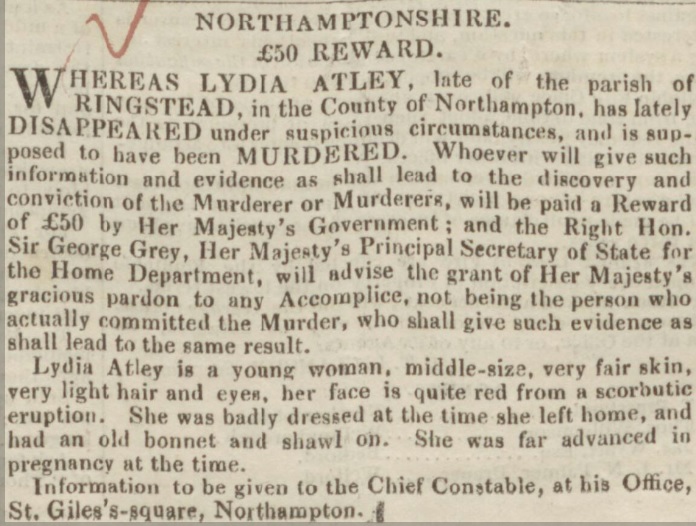
On 12th August 1850, a letter arrived from William Ball, a relative of Weekly’s. William wrote to say that he’d seen Lydia in the company of a man in Gold Street, Northampton, and his mother recieved the letter in Ringstead. She duly took it to the magistrate. Nobody believed this letter, and the following appeared in the Northampton Mercury on 14th September 1850:
Nobody came forward.
But Ringstead remembered.
In 1859, in the village of Little Addington, a skeleton was unearthed from a shallow grave in a field that had not been ploughed for a few years. Four inches deep, the skeleton appeared to be female, buried bent over. If this was Lydia, then nothing came of it: no arrests, no charges.
In 1841, the fields between Denford and Keystone had been enclosed, and the lane between the fields had become impossibly squelchy. In 1851, the road had been repaired, but at the time of Lydia’s disappearance, this lane was a mudbath, liable to sink any cart to the wheel axels.
On 4th February 1864, some men engaged in widening a ditch on this lane discovered a skull, fracturing it into three pieces when their shovel made contact. One of the men removed the skull, covered it with grass and went about his work. The next day, he quietly informed his boss that he thought he’d found the body of Lydia Atley, and his boss sent him and another man to continue excavation. They gently uncovered the rest of the skeleton, buried eighteen inches deep, and the police were sent for. In turn, they fetched the local doctor. This was one John Griffith Leete, a fifty-six year old doctor from Thrapston, who had no forensic training or experience. However, he was sure the body was that of a young woman, who had been in the ground for more than twelve years.
Weekly Ball was arrested anew, and his magistrate’s hearing followed on 22nd and 25th February 1864, attended by most of Ringstead. Almost fourteen years had passed since Lydia’s disappearance, but memories were fresh. Weekly was represented by Mr Gaches of Peterborough, and he cross-examined each witness with some skill. He cast aspersions on everyone, accusing John Hill of running a brothel, accusing Joseph Groom of having sex with Lydia, and claiming at least one other man was Lydia’s child’s father. If Lydia was a slut and Ringstead a hotbed of vice, then Weekly was not the father. And if he was not the father, why would he need to kill Lydia?
J G Leete was not exempt from this cross-examination. His exhumation and examination of the body was flawed, even by the standards of 1864, and the Gaches family held the coronership for Norman Cross, and knew a bit about remains. It seems that in the cold and dark February evening, Leete had been sloppy. He had not sketched the body in situ, he had not examined or sifted the soil for other evidence. When the hearing recommenced, Leete had to correct some of the evidence he had given earlier in the week. However, Leete had known Lydia – he delivered her first baby in 1848 – and he seemed fairly sure it was her.
An expert from London, William Orlando Markham, rescued the evidence somewhat. He testified that the body was female, about five feet two inches tall, and that it had been in the ground less than twenty years, but long enough to lose all the soft tissue. He noted the loamy soil in which the body was placed would cause a speedy decomposition. He also testified that the gap in the jaw was of a tooth that had been extracted shortly before death. Henry Dix was absolutely positive that it was Lydia’s jaw: he remembered the tooth he had drawn.
But where was the baby? Had it rotted or, as the two medical experts suggested, had Lydia given birth as she died? Her labour had been in progress all day. Had strangulation caused her to spontaneously give birth?
A man named Samuel Fairey came forward with more evidence, evidence that he had never shared before. He lived close to Weekly’s yard, and was a shoemaker. He got up with the dawn to work, and was up at 3am on 23rd July 1850. As he got ready, he heard the water pump in the yard go, and then stop. When he went to see who it was, there was nobody there. Poor Samuel and his wife were horrified when they learned they’d probably overseen a murder, and left Ringstead a few months later. Samuel testified that he was plagued with bad dreams, believing he had heard a ghost. I think it’s far more likely that he heard Weekly cleaning up.
More evidence was given about the letter that William Ball wrote in August 1850. He confessed in the hearing that Weekly had asked him to write it, and that he hadn’t seen Lydia. William’s mother was fetched to the court to testify that she had recieved the letter and passed it on. This testimony shook Weekly, who had stood unemotionless for the majority of the hearing, and when he was indicted for murder, he seemed thoroughly anxious.
The people of Ringstead were ready to lynch him, there and then. But they had to wait for the Lent Assize: not a long wait, they opened on 7th March. But while they waited, investigations continued in the spot where the remains were found. And another skeleton was unearthed, deeper than Lydia’s.
It transpired that, prior to enclosure, these fields had been used as Gypsy encampments. Perhaps they had buried their dead there? Although there is a marked difference between a rural, respectful burial and throwing a body face down, naked into a ditch, this introduced reasonable doubt. There was no firm evidence that this body was Lydia. There was nothing to compare the body to, no xrays, no DNA evidence, no hair, nothing. The gap in the jaw was perhaps the most compelling evidence, but again, this identity was rooted in the testimony of Henry Dix, a labourer moonlighting with a pair of grips.
There was absolutely no evidence that Lydia was dead. Only assumptions.
So when the case came to the assize, there was a long conversation between Mr Justice Crompton, Mr Sergeant Tozer, and the two barristers appointed to prosecute and defend Weekly. The evidence was strong enough to proceed to trial, but almost certainly not enough to convict. And if Weekly, a respectable man who had spent a fair amount of money on his defence counsel, was acquitted, then he could never be tried again if a more convincing body turned up.
They decided not to present the bill to the Grand Jury, the last stage in committing Weekly to trial. Instead, they discharged him so they could try him again if necessary.
Weekly Ball thanked his lucky stars, and ran away to Ramsey where he spent the rest of his life. His long-suffering, silent wife moved with him. She died in 1874, and Weekly died in 1896.
No other bodies were ever linked to Lydia’s disappearance, and I suspect this skeleton was hers and that she met her end in an orchard, in labour, at the hands of a man trying to cover his own adultery.
It is said that Lydia’s ghost still haunts Ringstead. I do not believe in ghosts, but if any spirit warrants restlessness, it is hers.
SOURCES:Bedfordshire Times, 9th Apr 1859, p.4. Northampton Mercury, 27th Feb 1864 pp.7-8; 12th Mar 1864, p.6.
Get in touch with your own family research problems and questions using the contact page above.
Sometimes I get the timeline muddled up, a terrible affliction for an historian I forget which came first, the death or the obsession.
It was, of course, the death.
I started to become an historian four days before my mum began to die. I don’t know what kind of historian I would have become otherwise. I was always morbid, always. Always thinking about illness, and how bodies are put together, how they go wrong and how they’re fixed. How they’re not fixed. What pushes a body into becoming unfixable. But watching Mum die was new, with new knowledge of just how much humans can take before they cannot.
Mum’s death was not the first. The first came in 1995 when my friend at school died of cancer, and our choir sang at the funeral. A teacher died, another old school friend, grandparents, a neighbour, another neighbour. Deaths that gently laid on top of each other in my heart. A heaviness, a compression, not destructive, just weighty.
Mum’s death broke my heart. As the eldest daughter, I was at the centre of the storm, and the story. My role was to explain, over and over and over what was happening, what had happened, what happened next. It was not a narrative I could escape. Even now, I cannot tell the story of my life without telling the story of her death. She made me, in more ways than one.
There is a great gulf in understanding how someone dies and understanding how someone dies. My mum died of cancer. That’s how. She died on a bed in the dining room in the night. Another how. She died amongst constant vigils by siblings, children and husband. Another how. She died slowly, but fast. That’s how. There was nothing unexpected. It was still shocking. How she died became the pivot point of a maelstrom, a strange, bewildered grief shared by everyone who loved her. How could she just die?
We can know the story, tell the story, but we cannot always understand the story.
Six years is long enough for the shock to ebb away. It is long enough for the anger to mostly be gone. The abyss that opened in front of me six years ago, with that first great grief, is less terrifying. You learn to build a pathway, shaky and unstable, but a way through the dark unknown. The grief stays with you, a love with nowhere to go.
I plough my grief into words, and hope this…somehow…keeps her alive.
Everything I do is infused with my mother’s memory.
According to family lore, a fireball once manifested in my family’s home. My great-great grandparents lived on the edge of Sutton Marsh, in an isolated house. One day, so the story goes, there was a storm. This fireball was probably a manifestation of ball lightning, although it did not behave as it should have. A fireball came down the chimney, and floated through the cottage living room and out of the window. I have so many questions. Did my ancestors open the window to release the ball of flame, or was the window already open? Did they scream? Did they try and touch it? Was my great-great grandfather unflappable in the face of danger?* Or was he equally startled by this strange occurrence? Did they think it was an act of God?
My mother grew up in the same house, many years later, knowing this story and was always terrified of thunderstorms. In my childhood home, there was a downstairs bathroom – a windowless cupboard – and she would hide in there during storms. When we went camping on the cliffs of Happisburgh, she would sit in the car during the inevitable sea storms, regardless of the time of day. She could not be reasoned with: she knew that electrical storms are unpredictable.
They are particularly unpredictable around fens and marshland. The newspapers of the 18th and 19th century abound with tales of weird lightning, of unusual survivals. While categorising my accidental death data recently, I found a story that I could not explain. I gave it a category of its own: Act of God.
Helpston, summer 1876, ‘swarthy summer, by rude health embrowned‘, in the words of its most famous resident. The Dolby family lived between the main village and the railway station, in a small cottage. This area is now lined with houses on both sides of the road, but was formerly much less populous.
The Dolbys were a large family. William and Mary married in the village in 1848, and had thirteen children – two girls and eleven boys. In 1876, twelve of these children were still living. The oldest six children had moved out, either to get married or work in service. Elizabeth was the eldest child (and only daughter) still at home. She had turned fifteen in April, but was not yet in service. Instead, she helped her mother with her abundance of brothers: William (13), James (9), John (8), Mark (7) and Frederick (5).
The weather that summer was hot, relentlessly hot. But, it broke on the night of 23rd July, a Sunday. Storms rolled in, and caused horrific damage across the Lincolnshire, Rutland and the fens. Countless livestock animals were killed, barns burned, trees were felled. A boat was hit by lightning, knocking all three of the crew out for hours. A railway stoker was killed at Horncastle, and a woman’s arm was broken in the same town. Two men in Walpole St Peter were struck by lightning, but only experienced their eyebrows being burned off.
In Helpston, the Dolbys went to bed as usual. William went to bed early, but heard Elizabeth go to bed at 9:30pm – she would have presumably been engaged in tidying while her brothers were settled. William and Mary Dolby slept in one room. Elizabeth and her brothers slept in another. On this evening, only Frederick and Mark were home – the others perhaps staying with one of their newly married older brothers in the village.
In the early hours of the morning, the storm woke William Dolby up. There was a tremendous smell of sulphur, and he could not move, feeling pinned to the bed by the sheer oppression in the house. Once the feeling had passed, he rushed to the children’s bedroom. Mary’s actions are not mentioned, but it’s likely she went with him.
The room was badly damaged. The mortar on the walls was destroyed around the windows, and on the wall on the other side of the bed. A scythe resting against the wall was destroyed, and one of the ceiling beams had been badly damaged.
William’s instinct was to get his children out of the house. The boys had woken up, and were unharmed. Elizabeth seemed to be asleep. William picked her up to wake her.
She was dead.
A message was sent to Dr Stafforth at Market Deeping. He recieved the message at 4:30am, but did not arrive in Helpston until after 10am. Elizabeth had been struck by lightning. Her hair was singed, and her chest bruised.
The lightning had hit the house, most likely through the roof. It had destroyed a beam, and rebounded, striking the walls either side of the beam. It had hit a scythe – the only metal in the room – and hit Elizabeth in the chest, killing her, but leaving her two little brothers entirely unharmed.
The jury at the inquest donated their fees to William Dolby. He went home to repair his house, and his wounded life. The Dolbys remained in Helpston. William died in 1886, and his wife died in 1897.
Lightning is a capricious phenomena, a strange and lethal force. But when it strikes, there is nobody to blame. An act of nature, an act of God.
SOURCES: Peterborough Standard, 29th July 1876, p.6, Edinburgh Evening News, 29th July 1876, p.3.
* The men of the marsh were not easily perturbed. My mother delighted in telling us how my grandfather would light fireworks on Bonfire Night, and morosely go back to the ones that didn’t go off, picking them up and checking them before relighting them.
Get in touch with your own family research problems and questions using the contact page above.
My maternal family come from the area where the Nene meets the sea. I grew up with tales of marsh lights, pulling men to their deaths, and with a healthy terror of the invisible creeping tide. But the actions of people can be far darker and more mysterious than the dangers of the landscape.
Maria Martin was born in Holbeach in 1833. She moved to the marshes around Sutton Bridge in childhood. Long Sutton was known as Sutton St Mary at the time, and her father Abraham was a sluice-keeper on Sutton Marsh. In 1855, she married William Burridge. William was the same age as Maria. He was born in Littleport, but had also moved to Sutton Marsh in childhood. After their marriage, they lived on the very edge of Sutton Bridge. William worked on the land. They had three children, although one died in infancy.
William was a drinker, and he was not very stable. In September 1862, he went to work, reaping. He was extremely drunk. In the evening, the other workers went home but William did not – they assumed he’d fallen asleep in drink. One told Maria that he was asleep in the field, so Maria went to rouse him. She found him dead. He’d strangled himself with his own belt.
Maria was twenty-nine when she was widowed, and had two young children – Abraham was nearly four and John was a baby. She lived in Long Sutton, and attended the Wesleyan chapel in Sutton Bridge. The chapel now appears to be a kebab shop. Maria played the harmonium in the chapel, and this is how she met Kirby Wilson Triffitt, one of the choir singers.
Kirby was a year younger than Maria, and born in Sutton Bridge. He lived with his parents on Bridge Street, and worked variously as a carter and brickmaker. He fell in love with Maria, and their relationship began in 1863. However, Maria refused to marry him. As a widow, Maria would have been reliant on out-relief from the workhouse at Holbeach to maintain herself and her children. Any impropriety could see that money taken away, and it doesn’t seem Kirby was either respectable enough or rich enough for Maria to marry.
In the summer of 1869, Susannah Richardson died in Sutton Bridge. Her husband, William Pearson Richardson, began to court Maria very soon after. They probably met in the chapel. William was not exactly rich, but he had a smallholding and sufficient money to have the vote. He was some eighteen years older than Maria, with three adult children. He seems to have been a far more attractive potential husband than Kirby, and Maria accepted his marriage proposal in March 1870.
Kirby was furious. On 15th March, he went to Maria’s house, banging on the door. She did not answer, and he assumed this was because William was on the premises, so he broke down the door. Maria was alone, and much aggrieved at this invasion of her home. She summoned the police, and Kirby was dragged up in front of the magistrates a week later.
The magistrates fined Kirby 23 shillings for breaking and entering, a substantial sum for a labourer. Kirby was incensed at the fine, and told the magistrates a dark story. He told them that he’d been in a relationship with Maria for seven years, and during that time, she’d borne three children. All three had subsequently vanished, and he’d killed one of them himself and buried it.
Absolute scenes!
The police investigated promptly. Kirby took them to his father’s house, pointed out the grave, and they exhumed the remains of a tiny child. They then arrested Maria and dug up her garden but found no evidence of any other babies. However, based on this bleak discovery, Kirby was also arrested. They were charged on 1st April, and subsequently bailed: William Pearson Richardson paid Maria’s bail.
According to Kirby, the first child was born in 1864. Maria had passed the baby to him over the fence, and asked him to dispose of it. She said that if Kirby did, she’d marry him. Lovestruck Kirby took the child to bury it, and as he laid it in the grave, it cried… so he stomped on it. Maria had been pregnant two more times since then, but he had no idea what had become of the babies.
The inquest on the remains showed a slightly premature infant, but there was not enough remaining to determine the sex of the child, or whether it was born alive. Kirby changed his story slightly at the inquest. He said he had not killed the baby, it was already dead. He also said Maria had been pregnant in 1865, but not a third time.
Maria denied everything throughout. She said Kirby was jealous that she was marrying another man, and had invented the story to ruin her.
Maria and Kirby were both charged with concealment of birth, an offence which could be punished by up to two years in prison. The case came to court on 29th July 1870, at the summer assizes at Lincoln. Before any case was tried at the assizes, it was shown to the Grand Jury, who decided which cases proceeded to full trial and which could be thrown out. They threw out the case against Maria.
The case against Kirby, however, proceeded and he pleaded guilty. He didn’t really have a choice: he’d told the police about the child, and taken them to the body. So, no evidence was heard, but the judge made extensive comments on the case.
The judge did not believe a word of Kirby’s story. He didn’t believe they’d been in a relationship, he didn’t believe Maria had any children with Kirby, he didn’t believe the child in Jeremiah’s Triffitt’s garden had anything to do with Maria at all. Maria was respectable, Kirby’s vengeful lies were not believable.
He sentenced Kirby to a year in prison, which he served in Spalding gaol. Kirby died in 1873, unmarried, aged thirty-nine.
Maria married William Pearson Richardson at the end of August 1870, barely a month after the trial. However, she died in 1878, when she was forty-five. She had no further children with William. William married a much younger (and heavily pregnant) woman in 1881, but died in 1882.
So, who to believe? Maria was a respectable woman, apparently entirely beyond suspicion. She was respectably engaged to a decent man. She never wavered from her denial.
Yet, Kirby’s story has a ring of truth. He loved her, wanted to marry her, disposed of a child for her, held out for her for years, and was rejected for a richer, older man. I expect more families had dead babies buried in their gardens than they ever would have liked to admit, but there were no other obvious maternal candidates in the Triffitt household.
Pregnancy was very difficult to avoid for sexually-active women in the nineteenth century, but abortion techniques were widely practised. Maria was no innocent girl: she was in her thirties, and had at least three children with her first husband. And there were plenty of local waterways to dump an unwanted baby in, especially if you’d grown up living on a sluice…
This type of story – that of the spurned lover – often ends violently, but Kirby was more subtle. He tried to ruin Maria’s reputation, but it backfired spectacularly.
SOURCES: Globe, 31st March 1870, p.4. Lincolnshire Chronicle, 8th April 1870, p.6. Stamford Mercury, 8th April 1870, p.6 and 5th August 1870, p.3.
Get in touch with your own family research problems and questions using the contact page above.
Recently, I’ve been working through local inquests from 1887, which involves a lot of newspaper reading. Local newspapers reported national and international news, so there’s been many interesting stories: Queen Victoria’s Golden Jubilee preparations and celebration echoing the current Platinum Jubilee, the push to get Katherine of Aragon a proper memorial in Peterborough Cathedral, the concerns about water quality in Stanground and Werrington.
But one story really grabbed me. A story that seemed too fantastic to be true. A story I assumed the papers had luridly distorted. The story of George Grice.
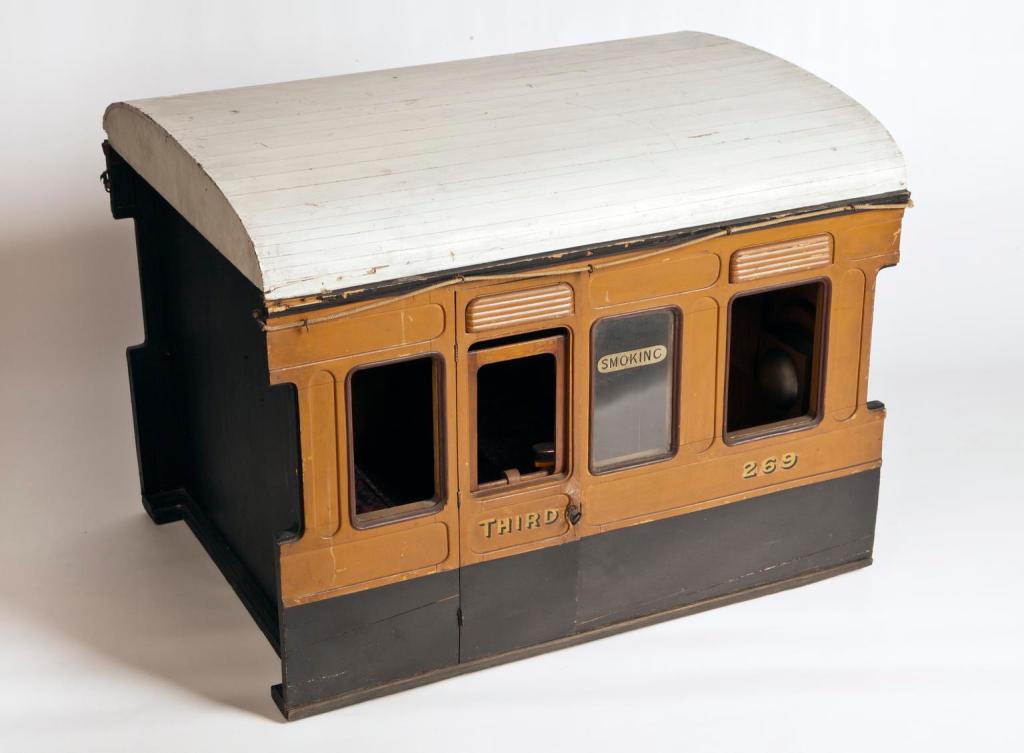
On Saturday 27th August 1887, Catherine Scraggs was travelling in a third class carriage on her way home from Stoke on Trent to Shrewsbury. Catherine was a woman of impeccable character, a teacher at St Mary’s board school in Shrewsbury. Other people had travelled in her compartment and left the train at Wellington. At the time, railway carriages did not have internal corridors. You entered your compartment from the platform, and there you stayed until you arrived. This made them rather dangerous for ladies travelling alone.
1901 Model of a third class coach, created as evidence in the murder trial of George Parker. Item from National Railway Museum.
The tickets were checked at Wellington, and just before the train departed, a man joined her in her compartment. Catherine was reading a magazine, and appears to have paid little attention to the man in the carriage at first.
As soon as the train left the station, he moved to sit next to her. He asked her a question, said something about his wife in Shrewsbury, then put his arm around her. She asked him to get off, and said she would call for help.
So he smashed her in the face, and started ripping her dress. He tried to force her down, but she managed to resist him. They struggled to the window, his hands around her throat. The window was open, so she reached through and got the door open. Grice then tried to push her out of the door, and when this failed, he slammed the door on her arm. Catherine held on for dear life, screaming bloody murder. Grice laid down to unbutton his trousers.
In the smoking compartment next door, Alexander Graham and another gentleman were enjoying the ride to Shrewsbury. Alexander was about twenty-six, and recently passed the bar exam. He’d taken a job at Shrewsbury as a barrister. He was unmarried. He heard Catherine screaming and put his head out of the window. He screamed at her not to jump, and grabbed hold of her free arm. He drew her through the door and into his own carriage, along the footboard. A footboard is a narrow platform that runs around the carriage: it’s not wide enough to stand on properly. The train was travelling on the main line, at 30 to 40mph. Other trains would have passed them – Shrewsbury is a busy interchange. To move along the carriage in this way was suicidal, but infinitely preferable to being left with the homicidal rapist.
Mr Graham pulled Catherine in through the window. And Grice, perhaps assuming she was simply going to another empty compartment, followed her. Imagine Catherine’s horror when his face appeared at the window.
Well, Mr Graham was a gentleman, and clearly neither shy nor retiring. He carried a concealed sword in a cane, drew his weapon and thrust it into Grice’s face. Grice withdrew, but stayed at the window, staring for a minute or two.
As the train passed Abbey Foregate station, Grice jumped off the side of the train, presumably thinking he would escape. However, he evidently hadn’t reckoned with the speed the train was travelling at. He landed, ran forward with the momentum and fell against the end of the platform, knocking himself out. He was removed to the infirmary shortly afterwards.
Catherine was badly bruised, and terribly shaken, but thankfully not badly hurt. Her nose had evidently bled profusely: the carriage was smothered in blood. She went to hospital to recover from the shock, but apparently made a full recovery and was able to give evidence a month later.
Grice recovered, and as he recovered, some very strange stories began to circulate in the local press. He was born in 1854 in Bradwell, and his birth surname was Grace. He moved to Tipton with his parents in the 1870s. He worked as an iron puddler, but couldn’t hold a job. And, he was supposed to be dead.
In early May 1887, a body was found suffocated on a spoil heap in Abercarn in Wales. A woman in a lodging house identified the body as Grice – then known as George Grace. An inquest followed, his parents were informed, and the body was buried. Two weeks later, Grice turned up at home in Tipton, furious that he’d been reported dead. Where had he been? Who was the body in the grave? Nobody seemed too invested in finding out.
In June 1887, still in Newport, he was arrested for a drunken assault. Between June and August, he made his way back to Tipton.
Grice’s background was full of deceit. He’d joined the army in 1877 and served in India. He was discharged in 1879 for lunacy. In 1879, soon after being discharged from the army, he raped Sarah Coggins, a 55 year old woman. His modus operandi was the same as with Catherine – he asked her directions, waited until they were out of sight and then punched her in the face. He had held her by the throat during the assault. However, the magistrates did not consider there to be enough evidence to convict, and acquitted him. Around this time, he impregnated Ann Edge, although it’s unclear whether this was consensual or not.
He re-enlisted as George Grace in January 1881, and was discharged. He enlisted again four months later as George Edge, using his girlfriend’s surname. Once again, he was discharged and re-enlisted under another false name – George Emmerton, his mother’s maiden name – for a fourth time in 1883. His army medical records note a diagnosis of imbecility and syphillis.
It’s unclear whether Grice’s head injury on the railway platform exacerbated his madness. He appeared in the magistrate’s court in late September, and told them he couldn’t remember anything. He was remanded to the Assizes in November, and found unfit to plead on account of lunacy. He was sentenced to be held at Her Majesty’s Pleasure and made his way to Broadmoor. He spent the rest of his life there, dying in 1934, aged eighty.
Alexander Graham remained in Shrewsbury working as a lawyer. I cannot trace Catherine Scraggs – if this was fiction, she’d have married Alexander, but alas, it was not to be.
SOURCES: Dudley Herald, 1st Nov 1879, Star of Gwent, 13th and 27th May 1887, 17th June 1887 and Wellington Journal and Eddowes Shrewsbury Journal, August-November 1887.
Get in touch with your own family research problems and questions using the contact page above.

 Sophie Michell