Today marks four years since my mum died. She died quickly, and slowly. From diagnosis until the end, it was a few days shy of three months. At the time, it felt like time had sped up, slowed down, that every day inched by and then was gone. And since she died, it’s been the same. She’s been dead for years now, but it feels like yesterday. I still wonder why she hasn’t phoned me for ages.
When she died, I had barely started on the road to being an historian. I knew I wanted to do it, I was a few weeks into my MA course, but I hadn’t specialised. Her death, and my grief, coloured my decision to start looking into death. I’ve always been fascinated by death, by the limits of human endurance. When my mum was dying, I needed to know the physical processes to understand why. I asked questions of medical staff, and I watched her deteriorate. I had to know why. It had to make sense. When you lose someone so close, there is an unreality about it, regardless of how expected it was: to understand the process of their death is to give your grief context
Part of the role of an inquest is to make a death make sense, to give it a story, a narrative that brings it together. That aspect of inquests doesn’t change.
Does grief?
Grief has become a theme in my work. Is the grief I feel for my mum the same type of grief that I would have felt in identical circumstances 150 years ago? Is the grief of a person for their mother, or a parent for their child different now to how it was then? Can I empathise with them? Can I do them justice? Is grief a fundamental emotion?
When I read an inquest, it plays in my head like a theatre production, but the characters are flat. I have to do more research to find out who they were, how their family worked. Inquest depositions are usually dry, reported speech with no inflection. The deceased is called ‘it’, not ‘him’ or ‘her’, but now and then a glimmer of despair, of panic; a reference to a witness being too distressed to attend, a wobbly signature. “She hadn’t been right since the child died” is a sentence that spoke volumes in the case of one poor woman. It’s finding these little tiny clues that give the stories life, and lead to meaningful analysis, because they are echoes of my own grief and shock and disbelief.
In four years, I have achieved more than I ever could have expected, but I have done it with a wound in my soul.
Since I last wrote, I’ve begun my PhD and it’s taking up a lot of time. As you’d expect. One does not merely walk through a PhD. However, I’m finishing up some commissions I took on before I even knew for definite I was DOING a PhD. And I have found a story that combines all my favourite things: death, inquests, community and justice.
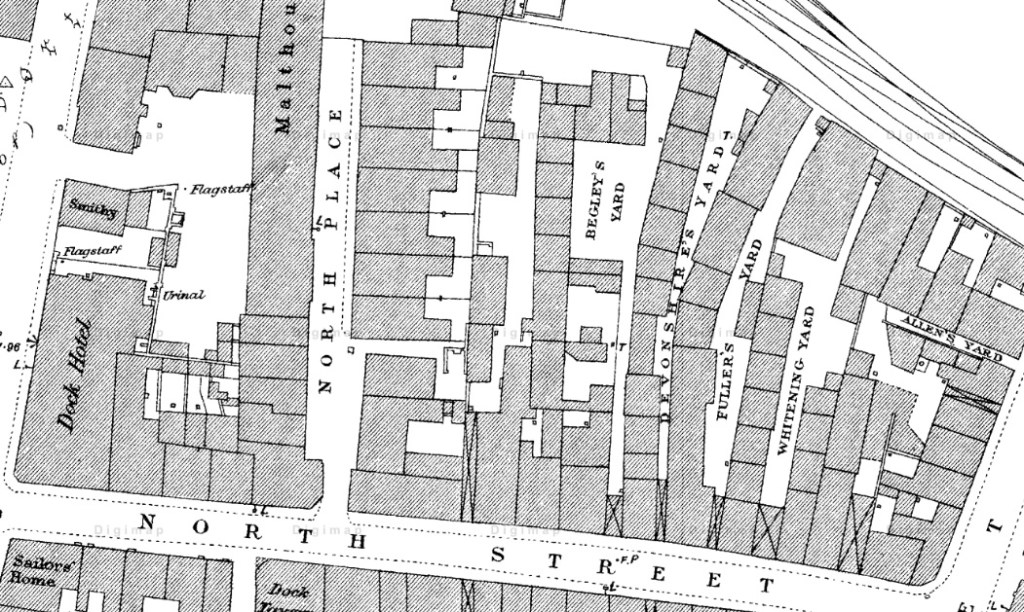
Our story begins in King’s Lynn in 1882. King’s Lynn was an important medieval port, but by the late ninteenth century, the main industry was fishing rather than shipping. Fishing families lived in tiny yards in North End, an area famed for being rough. One such yard was Whitening Yard, off North Street:
This is now a garage near the junction with John Kennedy Way. Several families lived here, in filthy conditions, but our story concerns the Newmans and the Baileys. Elias and Eliza Newman had married in 1874. Elias and Eliza had been living together for several years before their marriage, and had a brood of illegitimate and legitimate children – all perfectly normal for the area. Eliza had one son from her first marriage: James Stannard, known as Jim, born in March 1863, shortly after his father’s death. She had a further five children with Elias. Harriet, Agnes and Charles Newman were aged nine, five and three at the time of this particular incident. Elias sold fish for a living.
The Baileys were a fishing family. William and Mary Ann Bailey had married in 1860. Mary Ann was fourteen at the time, and over the next twenty-two years, gave birth to thirteen children. In 1882, only six were still alive. They were Elizabeth Maull, freshly married, aged twenty-two, with a daughter of her own, Harriet (18), Naomi (14), Susannah (11), Billy (8) and baby Harry (1). They had moved into Whitening Yard from nearby North Place relatively recently.
Whit Monday, the monday following Whitsun (the seventh Sunday after Easter) had been a traditional holiday for many moons before it was legally codified in 1871. Whit Monday fell on 29th May in 1882, and most people in the yards had the day off. Eliza Newman went to Hunstanton with her sister, and left her little children to have a tea party in the yard, overseen by a teenage neighbour. They set up a tea table and a little tent. Jim Stannard took his girlfriend, Kate Cannon, out for a romantic walk about Lynn.
The Baileys were also at home, but in foul temper. The Newman children’s tent was blocking access to their house. It’s difficult to precisely work out the order of the fracas that followed, but it seems that William Bailey was angry that his access was blocked, and threw their tent down, and kicked the tea table over. Then Elizabeth Maull threw a bucket of mucky water at the children. The children were very upset, and Jim came home to find his little sisters and brother in tears. And he kicked off.
The Bailey women shouted at him from their kitchen window, calling him white-livered. It seems Jim and the Newmans had insulted the Baileys (probably referring to them being rough), and Jim shouted “IF YOU WANT ANYTHING, COME OUT”, a Victorian version of ‘come and have a go if you think you’re hard enough’.
Alas, the Baileys WERE hard enough, and they DID come out. Elizabeth, holding her fourteen-month-old daughter came out first and hit him with baby’s shoe (probably a small wooden clog). Jim pushed her, and all the other Baileys came to her aid. William (now almost fifty years old), Mary Ann and their three older daughters beat Jim about the head for about five minutes, before a neighbour – Mary Panton of which more anon – broke the fight up, and took Jim into his house to clean him up.
A few hours later, Jim went out to meet his girlfriend and best friend. He told them what had happened, and how much his head hurt and how weird he felt. By Wednesday, he felt unable to go to work, although he did go out on the Saturday.
The following Wednesday was 7th June, and by this point, Jim was suffering. His mother described him as delirious and mad, pulling at his head. A surgeon was called on the Friday, and decided he was mad and prescribed him ‘medicine’. God only knows what was in the medicine. Oddly, Mrs Newman did not tell the doctor about the fight.
On Sunday, the 11th June, almost a fornight after the fight, Mrs Newman obtained a medical order from the Board of Guardians, enabling another surgeon to visit Jim. This surgeon, Mr Barrett, attended Jim until his death. He thought Jim had typhus. It wasn’t until the 13th that Jim’s aunt (who is not named in the inquest or court papers, but was probably Charlotte Felgate, married to Eliza’s brother, and also resident in Whitening Yard) mentioned to the doctor that Jim had been in a fight two weeks earlier. The doctor diagnosed meningitis, but it was too late, Jim died that evening.
An inquest was called, and it was attended by half of North End. And a curious mixture of lies, self-defence and posturing followed. It was the usual practice for coroners to allow people accused of murder or manslaughter to speak under oath, with legal representation, to get an idea of what had happened. However, the Baileys were not invited to speak. Instead, a hodge podge of residents from Whitening Yard gave evidence as to what had happened on Whit Monday. Eliza’s evidence was useless – she hadn’t been home. Elias wasn’t called to give evidence, nor were the children whose tea party had been demolished. Robert Felgate, Eliza’s nephew (14) gave some evidence that there had been a fight. Sarah Anderson, who had been in charge of the Newman children (also aged 14) gave evidence, but also claimed that the fight had last for half an hour! Then Mary Ann Panton, who had ‘rescued’ Jim from the fight claimed not only that he had started it, but that he had been drunk, raving, and stripped to the waist. However, the Pantons were related to the Baileys, and the coroner dismissed her contradictory evidence out of hand. There were six families in the yard, including Elizabeth Maull’s in-laws. The sole unrelated witness was Charlotte Money, who testified that she had seen very little, but heard the fight and did not think Jim had sworn at the Baileys. She later married into the Benefer family, who were related to virtually everyone in Lynn’s fishing community. Finally, Jim’s best friend and girlfriend testified that he did not drink, was very quiet and had not been right since Whit Monday.
The inquest was adjourned to the Town Hall, since it was obviously a case of major local interest, and the medical evidence was heard. The postmortem showed that Jim had meningitis, although they could find no bruise or fracture from the fight. Neither of the doctors who attended Jim were willing to admit that they had misdiagnosed a traumatic brain injury, nor that they could have saved his life if they’d realised it earlier, but it wasn’t really their fault. After all, Jim was quite delirious by the time they were called in, and his mother hadn’t told them anything.
You see, it seems that Elias Newman did not want his family upsetting the neighbours. He did not want the family dragged through the press. Perhaps he bought fish from the Baileys, or was worried that the fishing community would stop selling him fish. He told Mary Ann Bailey that Jim had been out late on the Saturday night and come back drunk, and Mary reported this to the coroner. But all the evidence suggests this was a fabrication to plant the idea that Jim’s head injury was caused by a fight with an Unknown Stranger rather than their next-door neighbours. It is likely that he told his wife to keep the origin of Jim’s illness from the doctors – after all, it was her sister-in-law that told the doctor about the fight, not his mother. Elias did nothing to suppress the stories about his stepson being a drunkard, even though his best friend and girlfriend testified that he didn’t drink much.
However, when the coroner questioned Elias, he found him unreliable. Elias claimed that his stepson had come home drunk after Elias was in bed and then Elias had ‘seen him go up the stairs’. But how, if he was in bed upstairs? Caught in this lie, Elias left the stand.
Harriet Bailey then claimed that Jim had in fact hit the BABY, that SHE was holding which was not backed up by any other evidence. Every other witness claimed it was Elizabeth who went out first. The coroner’s jury found William Bailey, Mary Ann Bailey, Elizabeth Maull, Harriet Bailey and Naomi Bailey had killed Jim by manslaughter. They removed Naomi’s name from the indictment as she was only fourteen, but the other Baileys were sent to trial at Norwich Assize.
Their trial was held in August 1882. The evidence was the same as at the coroner’s court, with a few additional questions thrown in by the defence lawyer. The defence lawyer decided that the Baileys’ best way out was to claim that Jim was a drunk, and by battering a woman with a baby, got what was coming to him from a bunch of women. However, the jury were unconvinced by this – perhaps seeing the four Baileys, all strong from years of fishing and manual labour, they determined that Jim never stood a chance – and found them guilty.
William went to prison for a year. Mary Ann, Elizabeth and Harriet went to prison for eight months. Harriet was seven months pregnant at the time, and gave birth to her son in Norwich prison (in the castle) in October. The baby’s father had left Lynn by the time she came out of prison, and she married into the Benefer family. Elizabeth was also pregnant, and gave birth in prison at the end of 1882. The Baileys all returned to Lynn after serving their sentences, although William died in 1890. Mary then moved to Grimsby with family.
The Newmans also remained in Lynn, but both Elias and Eliza died in 1883, and their younger children were raised by relatives.
True’s Yard Museum at Lynn holds lots of information on these families, including photos of the Baileys.
This is the sort of case I hope to dig into when I get into the research element of my PhD. Was the coroner’s court a place where you could expect justice? A place for airing dirty laundry or a place where family secrets could be kept?
My ‘book’ is still closed for full commissions, but do get in touch with any other queries.
SOURCES: Lynn Advertiser, 24th June and 12th August 1882.
I research death, study it, write it. From the average to the strange, the mundane to the suspicious. I spend my days finding how people died and ascribing meaning to the processes around their deaths. So, it becomes routine. But sometimes I find a death that stays with me, and sticks in my mind. This is one such death. The boy’s story has been told before, but this is my take on it.
This story begins in Docking in Norfolk, something of a regional anomaly. Docking is a large village, made very slightly larger when the West Norfolk railway opened in 1866, but it’s not exactly a central hub. However, it was the centre of Docking Union, formed in the 1830s, and thus had a large union workhouse on the road to Sedgeford. It also had its own magistrate’s court, held in the Hare Inn on Station Road once a month. The village was dominated, in terms of employment, by the manor of Docking Hall, part of the Duchy of Lancaster. Most men worked on the land, or in the many small plantations dotted around the village. Agricultural wages were low.
James Francis Playford married Susan Sadler in Docking in December 1867. He was thirty-four, she was barely twenty and very pregnant. Their first baby was a shortlived daughter born a few weeks after the wedding. Three sons followed: John Alfred in 1870, Edward James in 1872 and Robert Bell born on 7th January 1874. Bell was Susan’s stepfather’s surname. The Playfords lived on East Green in Docking.
From other evidence, which will be discussed shortly, it seems that James and Susan’s marriage turned sour around the time of Robert’s birth. Susan died in the summer of 1875, when she was twenty-seven.
James married again in 1877. His second wife was, confusingly, also Susan – Susan Bond. Susan was born in Docking in 1838, although she often claimed to be younger. Her early life appears to have been fraught – she grew up in Docking, and in 1856, was stabbed by a young female neighbour in the legs with a pitchfork. This fight appears to have been over a man. At the time of their marriage, she had given birth to five illegitimate children: Adelaide in 1859, Zachariah Charles in 1863, Edgar John in 1869, Laura in 1873 and Sarah Maria in 1876. One or two illegitimate children was quite normal, but five raised eyebrows. When she married James, she was a few months into her sixth pregnancy. In court, several years later, James claimed that he was the father of Laura and Sarah. This suggests their relationship predated Susan Sadler’s death. After their marriage, more children followed in quick succession. James was born in May 1878 and Albert in the first weeks of 1880.
However, our scene opens on Tuesday 11th October 1881. A normal day in the Playford household. Susan walked Robert and his siblings halfway to school after their lunch break, then went home. The other children returned that evening as normal, but not Robert.
When James returned home from work, he went to look for the boy. He informed the police the next day that the boy was missing and continued to search. The neighbours were slowly informed, primarily by the police, but Robert was not found.
On Saturday 15th October, Mrs Smithson was out early picking up sticks in a small woodland, after a night of howling wind. She thought she heard a dog whining, but on closer inspection, discovered poor Robert behind some railings. She fetched help to retrieve him, and carried him home. He was wearing just his shirt and trousers, and had taken his jacket and cap off1. Robert moaned all the way home, but his pupils were fixed and he was unable to respond. The doctor came and ordered the boy to be warmed, and given brandy and warm gruel, but Robert died in the afternoon. He was seven.
But why had he run away?
To answer that question, we need to go back to Robert’s birth. Laura Ann Bond was born in January 1873, and according to evidence given by James at Robert’s inquest, was his daughter. Within three months of her birth, Susan Sadler was pregnant with Robert, but it appears their marriage ended with his birth. Susan went to live with her half-brother, James George Bell, and took Robert with her. They lived with the Bells for around nine months, culminating in Susan’s death.
Robert then returned to live with his father. Susan Bond became pregnant again within a couple of months of Susan Sadler’s death, and this child was acknowledged by James at baptism. It is likely that they were living together before Susan’s death, and then of course, they married.
But Susan Bond did not appreciate her three stepsons, particularly on the meagre wage her husband brought in. The boys were not fed properly, they were not clothed properly. And they were savagely beaten by James and Susan. This was nothing unusual, and James talked about it openly in court – to stop the three boys running away, Susan had tied them to the door latch (the sneck) and beaten them. Robert was the youngest of the three, and apparently the most badly treated. Both James and Susan described him as melancholy and sullen, prone to run away and sulk, prone to be ‘queer’. Perhaps he was neurodivergent. Perhaps he was simply an abused, miserable little boy who wasn’t shown enough love, or given enough food.
In late 1879, aged five years and ten months, Robert was sent to the workhouse (which was in the village, so not far away) for two months because the Board of Guardians thought he was too thin. The workhouse master described him as terrified, emaciated and incontinent due to weakness. He would cry when adults approached, begging them not to hit him.
On 3rd December 1880, aged six, Robert was caught red-handed stealing another boy’s lunch at school. His immediate response was to run away, and he hid in some bushes for two nights. When he emerged, he was arrested and sent to the workhouse. At the end of the months, he was pulled up before the magistrates in the village pub. He refused to speak during his trial, if such a thing can be so described. Major Hare, the magistrate, reprimanded James Playford harshly: “We do not for a moment suppose this child stole the bag from desire of having possession of it; for we know well it was to suppress the cravings of nature. You had better the future see the child properly fed“. He went on to say that if Robert was caught stealing again, they would send him to a reformatory for five years, and James would have to contribute maintenance. He finished his comments by saying “Children cannot be neglected without causing injury to society“, and rather than imprison Robert, sent him back to the workhouse. Susan protested that she ‘could not do much for ten on twelve shillings a week‘ but the magistrates told her to ‘go on, we know all about that’. It’s hard to infer exactly what they meant – either they knew that the family were poor but didn’t care, or they were remarking on the fact that the reason there were ten children was because of Susan’s morals. In a village the size of Docking, where everyone knew everyone’s business, the latter seems more likely.
Robert spent most of 1881 in the workhouse, where he put on weight and became much happier. However, as harvest rolled around in August, the Board decided to discharge him. They hoped that he would be able to glean and thus help the Playfords out. Robert cried his eyes out when he was told he was going home. He was still only seven years old.
And so he went home, and within two months, the Playfords managed to starve him back to his emaciated state. In early October, lunches started going missing at school again. Robert ran away on his way to school: perhaps he had already been caught stealing and was afraid to go in to school and face the penalty. Perhaps his father had threatened him, because the family could not afford reformatory maintenance. Perhaps he had been particularly badly beaten. Neither James or Susan showed much concern about him running away – Susan was noticed to be acting completely normal and didn’t tell the school he was missing for two days.
Today, this would be a serious incident. Questions would be asked of all the ‘services’ involved in Robert’s care – parents, extended family, the school, the Board, the magistrates. But not in 1881. The coroner summed up at Robert’s inquest three facts: the boy was starved and cruelly treated by his father and stepmother, the boy was half-starved, and his demeanour was unlikely to be improved by the treatment he recieved. He noted the poverty of the family – James reported his weekly wage was sixteen shillings and sixpence, to support a family of twelve. He said that it would have been better if Robert had been sent to the reformatory, to be well fed and fairly treated – a damning indictment of the parents considering how strict reformatories were.
The official verdict at the inquest was that Robert died due to the want of the common necessities of life, accelerated by exposure to the inclemency of the weather of 15th October. They could not directly blame his parents, but censured them. There were no criminal proceedings as a result of the inquest.
Susan was the first weeks of pregnancy when Robert died. Her final child, Beatrice Anna, was born at the end June 1882. They spent the rest of their lives in Docking. James died in 1899, aged sixty-six. Susan outlived him, dying in 1931, aged ninety-three. The family did not appear in the newspapers again: perhaps they fed the children. Perhaps they stopped beating them.
Robert Bell Playford was seven when he died, although the newspapers reported that he was eight. He was generally known as Bobby. An angry, frightened, starving little boy. Everyone knew he was mistreated, but nobody could do much about it – the neighbours fed him when they could, but nobody had the money to feed him properly aside the workhouse. The workhouse had hoped he could earn enough to fend for himself, at the age of just seven, when they discharged him. The alternative was reformatory. So he hid in the woods and froze. One less mouth to feed, at least for a few months.
These are the stories that haunt me.
1 People suffering hypothermia will often experience extreme heat and sweating as their body shuts down, and remove their clothing.
2 There are two main sources for this story, aside from parish and census records: the Norfolk News, 1st Jan 1881, p.8 and the Lynn Advertiser, 22nd October 1881, p.7
I am delighted to FINALLY be able to announce that I am starting a PhD in history in October 2020 with the Open University. I have been fortunate enough to win full funding and a studentship through the AHRC Oxford-Open-Cambridge Doctoral Training Partnership, which I am SO excited about.
My thesis will be based on the preliminary investigation of Victorian suspicious death. I am obsessed with the Victorian coroner’s court, and its role in justice, as well as the personal stories of the families that came through the inquest system. I’m hoping to learn about the interpersonal dynamics as well as the structural dynamics of the court and how it worked in parallel with the police and criminal courts. I’ll be looking at cases across the Victorian era in Peterborough and Cambridge… so hopefully the archives reopen soon or I’ll be a bit stuck…
This will, obviously, take me a while, and that is why I have closed my books to full family trees for the duration, while I work out the right balance. I’ll let you know when that changes.
Recently, I had the odd experience of having one of my Facebook posts go slightly viral. Instead of getting 80 views and one pity share from my sister, it got 200+ shares and is currently on 25000 views. Perhaps this is not so surprising when the content is taken into account. I wrote about the Clarkson Memorial in Wisbech, a statue commemorating Thomas Clarkson’s work in abolishing slavery in the late 18th/early 19th century. Clarkson is perhaps Wisbech’s most worthy son, and the context of that post – immediately after the Colston statue was thrown into the river – clearly struck a chord.
But the Colston monument being consigned to the sea has been interesting from a historian’s point of view, as well as from a Black Lives Matter point of view. Before we go on, I want you to be in no doubt about my opinion: I absolutely support hurling it to the depths. I think recovering it to be preserved, to tell the story of this movement, on this particular day in Bristol, is an excellent idea.
An opinion I have come across many times, from the upper reaches of government down to random tweets, is that removing Colston’s statue was wrong, and is rewriting history, destroying an educational opportunity.
When it comes to people, statues are propaganda of the highest form. A statue does not randomly manifest. Decisions are made over who warrants a statue, who pays for the statue, and where the statue is placed. Decisions are made about what signage goes on the statue. Somebody decides what story this statue is going to tell.
To revisit Edward Colston, as I fear we must, he was born in 1636 and died in 1721. He was a slaver. He made an inordinate amount of money selling and buying slaves, and reinvested some of that money into the infrastructure of Bristol. When he died, slavery was entirely legal throughout the British Empire. In 1895, 170 years after his death, and sixty-two years after the abolition of slavery, a statue was erected to his memory.
Why then? Why not immediately after his death? Why did it take almost two centuries for Colston to warrant his image in bronze on the harbour wall? The statue was paid for mostly by one man, James Arrowsmith, who couldn’t even muster a thousand pounds in public subscription to put it up. One might say that if you cannot get people to pay for a statue, perhaps they do not want it. But the common folk are rarely consulted when it comes to the erection of statues.
So, is removing his statue rewriting history? Or even (and what a dreadful term this is in the context) whitewashing history? No. Erecting Colston’s statue in the first place was an act of whitewashing. Colston did not live in an era where slavery was absolutely fine: the Bible has a whole book about the damage of slavery (Exodus, you heathens) and it had been illegal in English law since 1102*. Colston’s philanthropy stemmed from his guilty conscience, according to some. And when his statue was erected, the black lives he ended for his own purse were gently erased from his biography. Almost the definition of whitewashing history.
History is rewritten daily. It’s the job of historians to sort through the Chinese whispers, surmise and barefaced lies of the past and try and find some truth. But a good historian knows there is no absolute truth. Historiography, the study of the development of a historical story, is a whole discipline by itself. To give an extremely obvious example, if the Nazis had won World War Two, we would know precious little about concentration camps. What is considered historically important changes from generation to generation, and how the past is depicted changes too. Our historic failures are framed as successes (see: Dunkirk evacuation), and our historic shame is covered up (see: entire British colonial history). History is mutable.
I think that’s a really hard concept to grasp. We are taught history in school as a procession of dates and glorious successes, starting in 1066 (somehow a success despite England losing), skipping over most of the medieval period to learn about Henry VIII’s sex life, and then some wars. I was taught the slave trade at school, but only as something nebulously linked to Britain, and very little about the practical horror of it. Maybe they just didn’t want to traumatise the kids, but in the same year, we learned about the Mai Lai Massacre.
The way British history is taught in schools is a choice that somebody makes. The curriculum is decided by a board. It does not self-generate.
Statues teach nothing. Over two hundred people have shared my post about Thomas Clarkson, many of them in Wisbech, with the same gist of message. “I didn’t know about this.” The Clarkson Memorial is a meeting place in Wisbech, you can’t miss it when you’re driving through town. People do not look to statues for education.
Destroying Colston’s statue did not rewrite history: Colston has been a figure of historical debate for at least one hundred years. Destroying Colston’s statue did not whitewash history: it’s erection did that. Destroying Colston’s statue did not destroy an educational opportunity: it created one. How many people have only learned England’s role in the slave trade in the last two weeks?
Destroying Colston’s statue made some people uncomfortable. Destroying Colston’s statue made people a little nervous that history might be more complex than a procession of glorious triumphs. Destroying Colston’s statue was a moment of synchronicity between the injustice of the past and the concerns of the present.
Destroying statues is a symbolic act, but so is erecting them in the first place.
* You could argue that the system of villeinage was akin to slavery, but that’s one for the medievalists.
This year has been really weird. As it stands, I’m home-educating three kids, all my speaking engagements have been postponed, and things are going to change again after summer. Yes, I know I’ve been hinting that Things Are Happening for months: another month and I’ll tell you what it is.
And, no, I’m not pregnant.
Anyway, I’ve decided to temporarily suspend full tree commissions. I’m currently booked up for a few months, and those orders will be honoured. But then I’m going to take a short break.
However, I’ll still be offering searches, and answering any smaller queries you may have: on houses, looking for people, helping out with dead-ends, or anything else you might need. So get in touch!
My last blog was about adultery and divorce. But divorce was only an avenue open to the very rich until divorce law was reformed in the 1920s, and again in the 1930s. What happened before then?
Bigamy. A crime where the punishment (a maximum of seven years in prison) was usually worth the risk, since it was so difficult to detect. But a bigamous marriage was not necessarily a happy one.
Henry Strutt was born in the City of London in 1847. He was the youngest child of Henry Warren Strutt, an admiralty clerk, and Henrietta Wilson. The Strutts lived in Grays Inn Lane, near Grays Inn, and demolished in the 1880s.
Henry may have been spoiled, as the youngest, with two older sisters fussing over him. He followed his father into a clerking job. In the spring of 1869, he impregnated Florence Mary Ann Foy. Florence was ten years older than Henry, the unmarried daughter of a merchant. It appears to have been love rather than arranged, and they married in October 1869. Six weeks later, Henry’s father died, leaving £1000 in his will. The modern equivalent is about half a million pounds: not a huge amount, but enough to settle down with.
Henry and Florence had five children across the next nine years, but the marriage was over by 1881. Henry does not appear on that census, and may have joined the army. Florence was living with her widowed mother-in-law, and four of their children. The eldest child, Florence Julia, had been sent to live in the Metropolitan and Police Officer’s Orphanage. It is unclear how this came to be organised, as Henry was not dead- perhaps he disappeared abruptly enough to convince all who knew him he was dead – and men had to have paid a penny a week as an insurance subscription to allow their children to attend if they died. Henry’s mother died in 1883, and by 1891, Florence claimed to be a widow on the census.
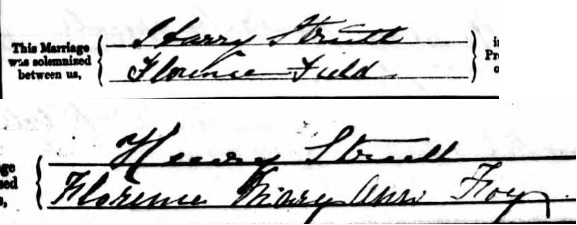
But Henry was not dead – he had reinvented himself in North London. Now calling himself Harry, and claiming to have been born in 1853, he had got himself a job at Pentonville prison as a warder. He had also met Florence Field, a girl from Dun Stew in Oxfordshire. Florence’s first child was born in Bournemouth in 1887, and was probably not Harry’s. Her second child, Harry Cecil, born in Islington in 1889, definitely was. By 1891, they were living together near the prison. In October 1892, with Florence pregnant again, they married bigamously in Barnsbury. Harry had changed his name and age, but he still used his real father’s name on the marriage registry, which is how I was able to trace him.
Harry and Florence quickly moved to Oxford after their marriage, presumably to avoid his bigamy being detected. Things did not go well. The baby Florence was expecting died shortly after birth. A final baby, Ethel, was born in February 1895. In January 1896, Florence’s daughter, eight-year-old Florence Louisa, stole a number of items from outside a shop. These items were passed to her mother, who tried to conceal them when the police came knocking. Florence Louisa was bound over to keep the peace, but Florence was sentenced to six weeks in prison for recieving stolen goods. This proved disastrous for the family, as Harry subsequently lost his job, and the family had so little money that Florence had to pawn her sewing machine, losing her only source of potential income. Both Harry and Florence placed advertisements in the newspaper following this incident begging for help, Harry referring to ten years served in the army.1
Harry and Florence were living apart in 1901, and Florence Louisa had been sent to live in a Nazareth orphanage, run by nuns. The couple reconciled, but separated again in the autumn of 1904. Harry lost his job at the University Stores in March 1905.
On 26th April 1905, Harry was found dead in his lodgings. He had swallowed potassium cyanide. His landlady was surprised to learn that he was married, but testified that he had frequently expressed suicidal thoughts. Harry left three notes. The first blamed the loss of his job squarely on his wife, and her ‘quarrelling and nagging’, and asked his landlady to send his belongings to his daughter Ethel. The second mentioned the address to send the belongings to. The third was addressed to Ethel, then aged ten years and two months:
God bless you my darling Ethel. My troubles are more than I can bear – Dad
Florence was present at the inquest, but not questioned, which is a curious omission. However, their son, Harry Cecil, then aged sixteen was questioned. He didn’t know why his parents were living apart as they had ‘such a happy home’. He also testified that he did not know where his father was living, although he had seen him in the city. This is an interesting point: Harry had no difficulty vanishing and keeping his movements secret, even while living within a mile of his family. Harry Cecil testified that his father owned potassium cyanide for cleaning his old military accoutrements. His death was registered as suicide while of unsound mind. His other family were not mentioned.
Florence never remarried. She died in Oxford in 1909, shortly before she turned forty-three.
Florence Mary Ann, his first wife, also never remarried, possibly because she suspected her husband was still alive. She died in 1929, aged ninety-one.
Harry had five children with his first wife, and three with his second. All of his first family were raised believing their father had died – all the adult children listed their father as a deceased clerk on their marriage certificates. They were: Florence Julia (1869-1939), William Warren (1870-1883), Alice Harry (1873-1931), Henry Russell (1875-1941) and Mabel Marion (1878-1931).
His three younger children were: Harry Cecil (1889-1915, killed in action), Millicent (born and died 1893) and Ethel. I am unable to trace Ethel, although she was still living in England in 1915. She may have emigrated.
It is highly unlikely Harry’s second lot of children knew about the first, and vice versa. The art of getting away with bigamy was total secrecy, and although it seems Henry Strutt managed this admirably, it came at a price beyond money.
1. Oxford Times, 18th January and 26th March 1896. I can find no record of Harry serving in the army, although this would explain where he was between the birth of his youngest child from his first marriage in 1878, and the birth of his son with Florence Field in 1888. It is possible that he enlisted using a false name, and was thus able to ‘disappear’.
I love Victorian divorce papers: little treasure troves of sex and intrigue among the middle and upper classes. Tiny insights through the heavy-backed curtains into the horror and pain of domestic violence. Things you weren’t supposed to know, laid bare, clinical, legal. A rupture in Victorian morality, a wound in the cosy domestic sphere.
When my husband was researching a ship for me, he mentioned that the ship-owner, John Henry Harrowing, had divorced his first wife on account of her committing adultery with no less than three men, I couldn’t resist looking it up. “I bet there was more to it than that“, I said. And boy, was there!
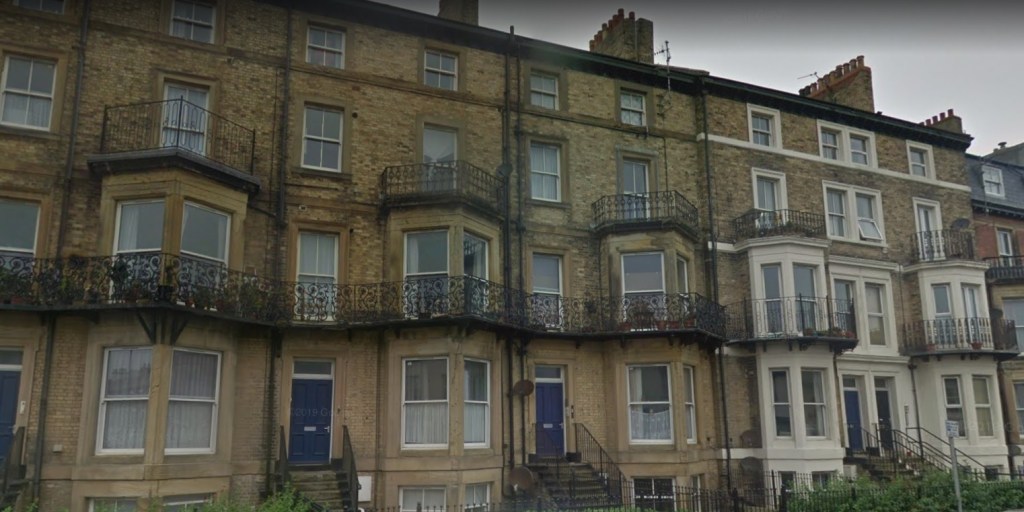
John Henry Harrowing was born in Whitby in 1859. His father, Robert, had been a tailor, but went into shipping in the early 1850s. The Harrowings were wealthy. John’s mother, Jane Ann Tesseyman, was Robert’s second wife. She was from Northallerton, and her father made timepieces. Robert and Jane had married in 1856, four years after his first wife died in childbirth, and Jane raised his surviving daughter. They lived in newly built Havelock Place overlooking the harbour mouth:
John’s mother, Jane, died giving birth to her short lived seventh child in 1866, aged thirty-eight. Robert left his children in the care of his elderly mother, and remarried in Croydon in 1871. Although this was a long way from Whitby, his business was based in East Cheap in London. His new wife was Catherine Isabella Wilkinson, from Sheffield. They had no children together.
At some point after this third marriage, Robert purchased Aislaby Hall, three miles from Whitby. The seven surviving Harrowing children moved in with their father and stepmother, and probably their elderly grandmother as well, although she died in 1874. The children’s number reduced to six in 1876, with the death of the eldest son Robert, aged nineteen at Balby. The number reduced again a year later, when John’s sister Emily died at the hall, aged fifteen.*
John Henry Harrowing took a more prominent role in the family business, as the eldest surviving son, after his brother’s death. He studied at Kings College in London. When the census was taken in 1881, he was living in Paddington. While living in London, he met Ada Potter.
Ada was born in Forest Hill in London in 1866, the daughter of John Vincent Potter and Ellen Hackney. John and Ellen had married after their first two children were born, but were otherwise respectable. John was an accountant in the city, but died in 1876. He left his widow and six children with a small estate (£1500: about £700,000 now), but they appear to have scattered after his death. Ada’s whereabouts in 1881 are unknown.
John married Ada at Holy Trinity Church in Beckenham on 18th November 1885, when he was twenty-six, and she was nineteen. The marriage was witnessed by Ada’s sister Helen, John’s father, stepmother and his sister Annie.
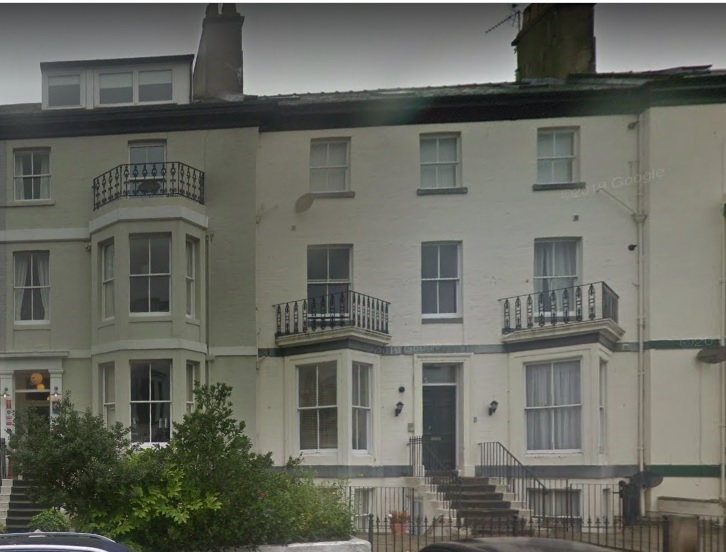
Ada was either already pregnant, or became pregnant immediately, and their first baby was born in Whitby on 4th August 1886. A second son followed on 6th May 1889. When the census was taken in 1891, Ada and John lived on the Esplanade at Whitby (now West Terrace, yards from Havelock Place):
They also owned a house at Ruswarp, called Turnerdale Hall:
They also owned Woodleigh House, down the road from Aislaby Hall, which I cannot find a picture of: it’s still standing.
In August 1893, the pair separated. And in October 1893, John filed for a divorce, which shocked and delighted the newspapers.
A quick note on Victorian divorce law. Women were not permitted to divorce their husbands unless they could prove both cruelty and adultery, and even then were likely to become social pariahs. They usually also lost custody of their children. Men could divorce their wives for adultery alone, and tended to have the resources to do so: divorce was expensive.
So, on the 3rd October 1893, John filed for divorce on account of Ada’s adultery with two men: Charles James MacColla (a French-born solicitor), and Captain Percy Monson (a rather disreputable American with numerous aliases). Three weeks later, he added the name Robert Henry Garratt. Three days later, he agreed to pay Ada £7 10s a week to keep herself (about £3300 a week in today’s money). She was allowed to see her two little boys for four hours, once a month, at John’s home. In July, her monthly contact was suspended on account of her ‘molesting’ her husband and children. It’s unclear what was meant by this: perhaps she was hysterical, or tried to take the children away.
A flurry of affidavits, claims and counter-claims went between the solicitors of the two parties, and it wasn’t until November 1894 that the case came to court, and hit the newspapers. The divorce papers do not feature any subsidiary evidence, but there was plenty of it mentioned in the court papers, mostly generated by John’s family: intercepted letters that Ada had sent to her friends, testimony by John’s family and friends. However, I can only base this write-up on what I have been able to read myself.
Ada’s divorce was contested by Robert Garratt, one of the men accused of adultery with her. According to the newspapers, the marriage was happy until they met the Garratt family. The Garratts were family friends of the Harrowings, and the evidence of Ada and Robert’s adultery was chiefly based on John walking in on Ada alone with Robert once, and on Ada walking around Whitby with him. The affair was said to date from the summer of 1890. One man testified that he’d seen Ada and Robert go into the Harrowings’ house on the Esplanade when it was otherwise empty. Another man claimed he had seen Robert and Ada together in the woods, but it was strongly intimated that this was part of a blackmail attempt: “Anything would get to be a scandal in Whitby” said Robert. Robert’s wife testified that she did not believe he had committed adultery with Ada, but that John had forbidden Robert to enter the house. John’s sister, Helena, and an unnamed aunt testified that Ada and Robert had been alone together on several occasions. A cook called Jessie Wilkinson, who may have been related to John’s stepmother, also testified that Robert had been in the house when John was not. John claimed Ada had become a different woman after she met Robert Garratt, losing her ‘modesty and delicacy’ towards him.
Ada announced at Christmas 1890 that she was going to stay in London, and John had followed her and found her in a hotel – he suspected she had gone with Robert Garratt, but Robert was actually in Liverpool with his family. John then hired a private investigator to watch where Ada went. In 1891 or 1892, depending on source, she left again, and the investigator found her staying at Margate with Charles MacColla. The case against Percy Monson claimed that Ada had picked him up at Margate aquarium and promptly gone to stay at a hotel with him. In 1893, it was alleged that Ada and her sister, Helen Newton, had set themselves up as high-class prostitutes at Bedford Place in Bloomsbury. John also testified that Ada had falsely accused him of adultery and attacked him on more than one occasion.
The court found that Ada had committed adultery with both Charles MacColla and Robert Garratt, and Robert was ordered to pay John £300 in damages. The court did not find she had committed adultery with Percy Monson, although no reason was given for this discrepancy: perhaps the court did not think it feasible that Ada was a prostitute. Ada was ordered to pay the costs of the divorce. The courts later decided Ada did not have to pay all the costs on account of the cruelty she had suffered. By May 1895, Robert Garratt still hadn’t paid the money he’d been ordered to, and the divorce was not completed until July 1895.
It’s what the newspapers did not report that is of interest. They all made reference to Ada’s ‘counter allegations’ without elaborating on what they were. John was advised not to call Ada to give evidence at the divorce hearing, perhaps because they did not want her allegations to become public knowledge. John’s initial divorce statement claims that Ada committed adultery on 26th August 1893, in Greenwich and in early September in Margate, both with Charles MacColla. He claimed she had committed adultery with MacColla again in mid-September in London. In his first statement, MacColla was the only man he accused. He added accusations about Garratt and Monson later, after Ada had filed her counter-suit.
Ada’s rebuttal and counter-suit survive, and shed much light on their ‘happy’ marriage. In January 1886, when she was in early pregnancy and they had been married just two months, the couple were staying at John’s aunt’s house on Royal Crescent in Whitby. John came home drunk, pushed Ada over a chair. Later that evening, he physically kicked her out of bed, and Ada was ill for two weeks. This was the first of many occasions, she reported: he would kick her out of bed when drunk, not let her back in, and sometimes spit on her. When Ada left to go to London at Christmas 1890, she said John had thrown the contents of her bag all over the drive, grabbed her, and threatened to kill her. He then locked her in a room with him and his aunt, and wouldn’t let her out. Ada left John on this occasion, but in January 1891, he begged her to return, so she did.
A month after she returned, while saying her prayers at the bedside, she alleged John hit her around the head and shoulders, then woke up their eldest son (aged four) to tell the boy how his mother was wicked and ‘would for the devil’. Later that night, John kicked her out of bed again, leaving her bruised, pushed her from the room and locked her out.
In the spring of 1891, John grabbed her by the throat, forced her to her knees and nearly strangled her. At Christmas 1891, he threatened her with a revolver, and in January 1892, she left him again. She returned when he promised to behave better.
This time, things seemed to be better for a little longer. However, in September 1892, he threw Ada out of their bedroom by her neck, then threw her down the stairs.
In August 1893, around the time their marriage finally ended, and probably with proof from the private investigator that Ada had been seeing Charles MacColl, John called Ada a prostitute in front of their children and governess, then beat her about the head, pinned her to the floor with his knee and banged her head against the floor, and tried to strangle her again. He then threw her against the room into a wall, threatened to knock her brains out, and then kicked her over a chair. Ada was visibly battered and bloody from this assault, and left her husband a final time on this occasion.
Ada claimed her husband frequently called her a prostitute in front of her children (who were seven and four when the divorce proceedings began), encouraged the children to call her a prostitute, and told them not to obey her. She also claimed that her husband committed adultery with a woman named Jenny Atkinson on his boat, moored at Whitby, and at Turnerdale Hall.
John denied adultery. He did not deny that he had hit his wife, only that he had never been ‘excessive’, except ‘in self defence’. In court, he claimed Ada had attacked him – he went to some lengths to paint her as a hysterical prostitute.
John was a jealous husband: he admitted in court that he was jealous of Robert Garratt, and also of Ada spending time with her sister Helen. The fact that he was so violent towards Ada in their bedroom, and constantly called her a prostitute, long before he claimed to suspect her of adultery, suggests he experienced violent sexual jealousy and possessiveness of his wife. There is an undertone of sexual violence throughout Ada’s affidavit- although marital rape was unrecognised, many of their arguments occurred in the bedroom and strangulation is a frequent feature in rape and serious domestic violence cases.
Ada’s whereabouts before their marriage aren’t known, and her sister Helen certainly moved around London living with men she wasn’t married to, so it’s not impossible that Ada had been a ‘kept woman’ before she married John.
So the marriage ended. John returned to Whitby with his two sons. In 1897, he remarried. His second wife was his maternal cousin, Jane Ann Tesseyman, the daughter of his uncle William. Jane was born a year after John’s mother died, and was named after her. John and Jane appear to have been happily married: they had four children, and lived in Ruswarp. John inherited a vast fortune when his father, Robert, died in 1900. Robert left well over a million pounds, worth somewhere between fifty-five and eighty-eight million today.
John was knighted in 1921:
Sir John Henry Harrowing by Lafayette Whole-Plate nitrate negative, 7 July 1926 National Portrait Gallery x69096. Used under Creative Commons license
He died in 1937. His second wife, Jane, died in 1961, in her nineties.
Ada is completely untraceable after their divorce. She may have changed her name, or gone abroad. Robert Garratt is also untraceable. Charles James MacColl died in 1919. Percy Monson is untraceable, and presumably went back to the US, to continue to be disreputable and mysterious.
Neither of their sons had a happy ending. The younger, John, was killed in action in 1917, aged twenty-eight. The elder, Robert, suffered a head injury in the First World War, and shot himself in the head in 1932, when he was forty-five.
Iam grateful to Estella Harrowing and Jo for their information on the location of Aislaby Hall: the photo that previously featured on this blog was of a different Aislaby Hall, close to Pickering.
Just a brief note to say that production at the family tree factory is unaffected by coronavirus, unless I become ill, since I already work from home. Unfortunately, some talks I had planned for the summer have been cancelled,and will now take place next year.
I am now homeschooling three primary school children, and two have autism, so production may be a little slower.
If anyone in my family is unwell when your work is completed, I will delay printing, binding and posting it out for two weeks, to help prevent infection transmission. I will be in touch with any clients this affects directly.



 Sophie Michell